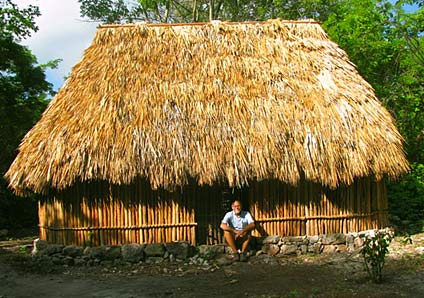
MFIL: Welcome back Jim, what are your plans during this second stay at Hacienda Chichen? I will be more in contact with the guests of the hotel, offering free Nature Guided Tours daily and Nature Talks in the afternoon at my Maya Hut, where guests can enjoy a fresh organic tea just picked up from my own backyard. Those that wish to receive my e-newsletter can join it.
MFIL: Where were you born and raised?
I was born in Madisonville, Kentucky and raised on a tobacco farm in western Kentucky, about 100 miles directly north of Nashville, Tennessee.
MFIL: Share a memory of your growing up that inclined you to be who you are today?
At first I had no special feelings for Nature. When I was around 10, however, for some reason I began feeling sorry for the animals we slaughtered to eat, and in a few years that led to my vegetarianism. At about age 15, I found myself sitting at the kitchen table copying the life histories of animals from books; so, I suppose that my "chronicling Nature" urge started then.
MFIL: What did you study at the University?
I received a Bachelor of Science in Biology and Geology, then my Master of Science in Botany from the University of Kentucky. At first I wanted to major in Zoology but when they refused to let me draw insects for Entomology instead of kill and collect them, I changed to Botany.
MFIL: Which former job or work gave you great satisfaction and influence you to commit to what you do today?
After graduate school for three years I worked at the Missouri Botanical Gardens in St. Louis, Missouri. They sent me to collect plants for taxonomic research in several tropical countries. When I saw with my own eyes the vast destruction of the Earth's biosphere, I felt that I needed to be more actively engaged in trying to protect it. I was naive enough to think that if I could tell people about the destruction, things would happen to stop it. So I quit my job as a botanist and became a freelance writer, which has been my main job throughout my adult life.
 MFIL: When did you first begin thinking about being a free-lance Naturalist?
While working as a botanist I realized that I wasn't the type to prosper in an institutional or organizational setting. If I was going to do anything I regarded as important, I needed to do it on my own to "freelance."
MFIL: What factors influenced you most in deciding the life-style you are so committed to live today?
I seem to have come into being with some very strong feelings about things. I feel strong empathy with animals, so I became a vegetarian. I can't stand spending my time doing things I don't think of as important, so I work at what I believe in, which means that I seldom get paid for it, and that leads to a low-income life. I don't like clutter, confusion and distractions, so my life style turns out to be very simple. I believe that if one is to get things done, a good body is needed, so I pay a lot of attention to nutrition, exercise and the like. When you practice your
beliefs, the lifestyle you end up with comes automatically, as a byproduct.
MFIL: What qualities do you think distinguish Naturalists from Scientists and other professional environmentalist people?
I think of all scientists as naturalists because they are all exploring the nature of Nature, be they biologists, physicists or mathematicians. I don't know that many professional environmentalists. I've met a few during plant-collecting expeditions I've been on, especially in Madagascar, and they were more like administrators. Most sincere environmentalists I know are private people in many walks of life, who, like myself, just found themselves with intense feelings that had to be dealt with.
MFIL: What attracted you to the Maya Foundation Volunteer Program?
First of all, it was allow me to stay in a new place Hacienda Chichen with a mix of plants and animals different from what I'd seen before, and thus with plenty of material for me to write about, especially in my weekly Naturalist Newsletter (www.backyardnature.net/n/). Also I produce a "Plants & Animals of the Yucatan" website (www.backyardnature.net/yucatan/) and a "Plants & Animals of the Mexico" site (www.backyardnature.net/mexnat/) so being here enables me to enlarge these, making them more informative and useful to visitors. Finally, as both botanist and freelance writer I've worked in about 40 countries, and I've never met people more pleasant and friendly than the Yucatan's Maya. Knowing that I could be among the Maya whatever volunteer I did for the MFIL was an important attraction.
MFIL: Briefly describe your volunteer work and daily volunteer activities?
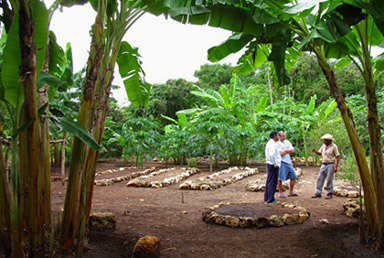
Mainly I remain flexible and help when help seems to be needed. If the person at the desk is having a quiet day, I may ask if he wants to learn some computer tricks, or how to use PhotoShop. When other volunteers are not here teaching English, I give classes whenever the employees have time and are interested. When the dry season came and foliage dried up and fell off revealing trash along the trails, I picked up many wheelbarrows of trash along trails near the hacienda. I've potted palm seedlings for future sales. In the forest if I find a bromeliad or orchid fallen from a tree, I bring it back and mount it at the Hacienda Chichen Green Resort where visitors can appreciate it. For the local bird guide I developed an announcement for him to place in town, advertising his services. Sometimes special visitors want some kind of special English-based attention and I may provide that, usually by showing them around, but also I can give extemporaneous presentations on local plants, animals and ecology. By giving Internet exposure to a local paper maker, sales of his traditional product to customers in the US were facilitated. Currently I'm engaged in developing an organic garden. This is a real hodgepodge of activities, the emphasis varying from week to week, but in the end it feels as if I'm contributing to the Hacienda Chichen's ongoing sustainable development.
 MFIL: How you spend your day as a MFIL volunteer at the Hacienda Chichen's Maya Nature Reserve and the social work you do?
My nature work is continual, never ending. Much of my time is spent at the Hacienda Chichen's vast property observing nature and developing my weekly Naturalist Newsletter which is read by thousands. I feel that that exposure in itself must be beneficial to the MFIL and Hacienda Chichen sustainable eco-cultural activities. My MFIL social work has supported many people, for example, I helped a rural Mayan man sell his hand-made traditional paper, in order to do that, for several days a lot of my time was required gathering pictures, information to create an article about Hand-Crafted Paper that I presented on the Internet. Basically, since I am always at the Hacienda Chichen, for a social project to develop, the management first must bring it to my attention, then we'll develop a strategy for dealing with it, and do something about it.
MFIL: Who you teach and who you feel has taken more interest in learning from you?
I have been here so long and am on such friendly basis with the staff that they all feel free to ask me for help at any time. Most frequently requests have come from the meal servers, who ask such things as what a Smoothie is -- something many North Americans ask for on hot days. So far Chef Josué Cime has most aggressively sought my help, first in special English lessons and now learning how to set up his own webpages featuring recipes he offers at the Hacienda.
MFIL: How satisfied are you as a MFIL volunteer ? If you could, would you change or improve the way the MFIL handles the volunteer program?
I am quite satisfied and feel that I have received much more than I have given. Each volunteer is a special case however, so I can't speak for others. Just that in my case I feel quite fortunate, and grateful.
MFIL: What have the rural Mayan people you have been in contact with taught you about their traditions while volunteering now?
I have learned an enormous amount via osmosis. It has ranged from José Tamay, the Maya Shaman explaining to me in detail the Maya calendar system, to just seeing how the employees relate to one another and do their work. The basic assumptions the Maya have about life are in many ways very different from those we have in the North. It enriches me to experience this other way of thinking every day.
MFIL: Where is your volunteer work with the MFIL at Hacienda Chichen's Nature Reserve heading? What plans you have to improve the Maya rural people and children's awareness and understanding to properly care for the environment, flora and fauna?
 The Hacienda Chichen's Nature Reserve is the large acreage accessible by east-running and south running trails where I have continually gather information and photographs on a variety of flora and fauna. All that material has helped me write my Nature Weekly Newletters and a lot of information about Yucatan's wildlife made available on the Internet in an organized, easily accessible format. Part of the hotel's Nature Reserve is the area where Maya rituals are performed; my earlier efforts to make the area more inviting to visitors who might like to go there, sit and meditate or look around. Now that rains are returning, I'll return to the Mayan Ceremonial Site to establish a defined trail to the pool and well area, and plant ferns and other pretty ornamentals I potted months ago for the project. Once the area is presentable, I'll create a paper page with a map to the area, a photo and text about what is so special about the area, inviting visitors to come to it.
MFIL What sustainable green project you plan to implement for the MFIL and this property?
At this moment there is renewed interest in developing a planned organic garden. I have already planted seeds and have seedlings ready for transplanting as soon as we define exactly what we want. During upcoming months I may be spending a good bit of time on this project. If we can develop some organic infrastructure and gather a few people who understand the basic principles and see what wonderful things it can lead to, that single project is more than enough to be involved in.
Some of Jim Conrad's own writing:
Dioon Cycads at Hacienda Chichen's Entrance
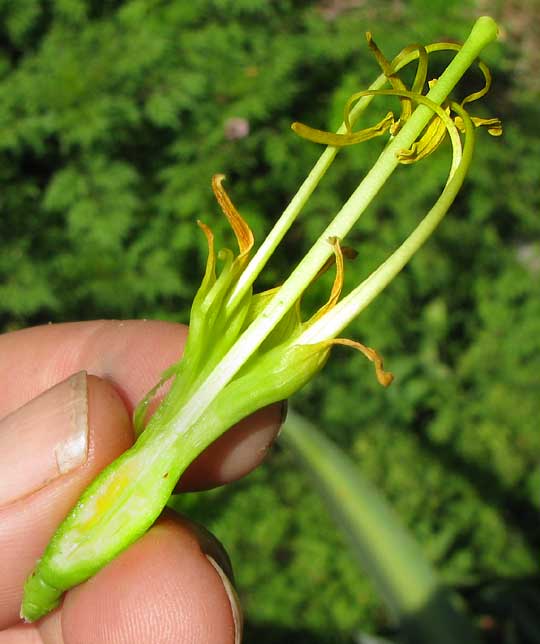
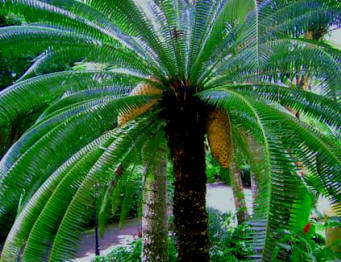 Even before I'd introduced myself to the Hacienda Chichen staff I got sidetracked at the office's entrance, admiring the handsome plant (picture above) "What on Earth kind of palm is that?" I heard myself almost say, before noticing the 21-inch-long (53 cm), pale-tan-colored item emerging among the fronds at the trunk's top. In fact, there were two of them, and you can see a close-up of the Dioon Cycads palm and cone fruits (main photo)
Palms don't produce fruits like that. Typical palm fruits are like small coconuts, for coconuts are indeed palm fruits. What's in the picture is some kind of cone. A good field mark for cycads of the genus Dioon is that the frond sections, or pinnae, bear several parallel veins -- there's no outstanding mid-vein or reticulation. Also, each pinna bears small, sharp, stiff "teeth" along its margins.
When finally I'd noticed all this I realized I had a cycad, one of those "living fossils" it's always nice to encounter. Cycads are gymnosperms and thus most closely related to plants such as ginkgos and yews, but really their closest relatives went extinct millions of years ago, so now cycads as a group occupy a rather isolated branch of the evolutionary Tree of Life.
Yucatan flora: Cycads at Hacienda Chichen Eco-Spa Resort, Chichen Itza, Yucatan, Mexico: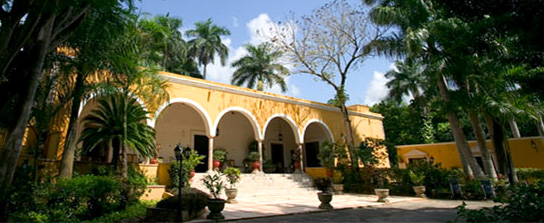
Visit our recommended Chichen Services Mayan Vacations Portal to enjoy Yucatan, Mexico:
www.yucatanadventure.com.mx
Yucatan Adventure Green Travel Guide is a volunteer Sustainable Green Travel Guide designed by the Maya Foundation In Laakeech A. C. a NGO sustainable civil society founded by Hacienda Chichen Resort's owners and staff in Chichen Itza, Yucatan, Mexico. Hacienda Chichen's sustainable green vision and eco-cultural mission committed to provide travelers a soulful Mayan cultural experience as well as a Green Getaway to explore the eco-wonders and cultural traditions of the Maya; as well as to support the welfare of Mayan rural communities and to promote Sustainable Geo-Tourism. Visit Hacienda Chichen Resort and Yaxkin Spa's website: www.haciendachichen.com
Enjoy Hacienda Chichen Resort's Flora Guide and Botanical Gardens beauty and serenity when visiting Chichen Itza, Yucatan, Mexico.
Published Photos & Information Courtesy of
Hacienda Chichen Resort and Mr. Jim Conrad
Maya Foundation In Laakeech A.C. Volunteer.
November 2009, updated April 2014, Aug. 2016, July 2018