2018 Travel Eco-News:
Great Eco-Vacation with 50% Price Savings
Rent Your Own Private Cottage at Hacienda Chichen for a very
Special Low Price per Week arriving on September and October 2018
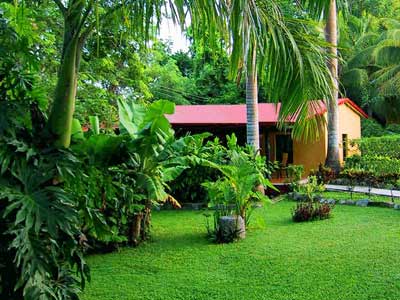
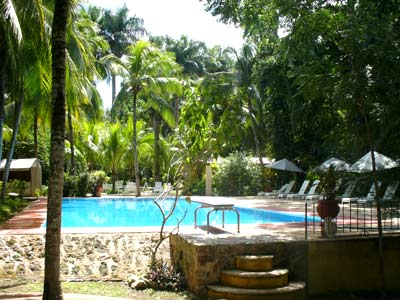
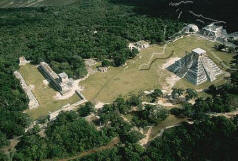
Don't miss out on a Great Cottage Rent Offer from Yucatan Haciendas' top Eco-Cultural Destination and Green Spa Resort! Located a mist the Mayan temples of Chichen Itza, Yucatan, Mexico, Hacienda Chichen Resort is offering travelers the unique opportunity to rent a private two double bed guest-rooms / two bathroom cottage with its own private patio terrace for the unique especial discount price of USD $ 899 plus taxes per week (six nights / seven days). Offer valid for arrivals Sept. and Oct. 2018 with a prepaid non-refundable non-cancelable reservation limited to cottage availability Don't miss this opportunity! Reserve Now
The ancient Maya civilization is the highest cultural legacy of Mesoamerica. The Maya are believed to originate in the Yucatán around 2600 B.C. They developed the mathematical position of zero, along with a highly advance understanding of the Cosmos, astronomy, their impressive calendar systems, herbal healing, majestic architectural achievements, sacred holistic ceremonies, and a complex hieroglyphic writing combining phonetic suffixes, prefixes and detailed artistic symbols within its format.
DID YOU KNOW: Ancient Maya had amazing technical skills; they erect highly decorated ceremonial architecture sites, including impressive temples, ball courts, pyramids, palaces, and observatories; such architectural skills are believed to have been built without the use of wheels and metal tools. Yet, the perfect harmony of their architectural achievements leaves even the most skillful scientists of today wondering how this ancient people arrived to such highly refine knowledge and understanding of our galaxy and the Universe. Learn why their cities and temples are rooted in their Mayan Cosmo-vision and how they managed to produce such incredible perfection in their architecture and mathematical achievements.
The Maya understanding and observation of nature were the key stones of their impressive cultural achievements and scientific accomplishments in various complex socio-economic and religious activates that played an important role in ancient Mayan urban planning, architecture, religion, astronomy, mathematics, literature, holistic healing practices, farming methods, calendar systems or Maya Cosmovision.
Read about Yucatan Endemic Snakes and other "Yucatan Snakes"
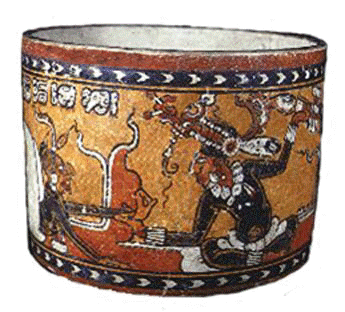
Mayan artisans were skillful weavers and potters, archaeologists have found a vast quantity of fine weaves and beautiful vases, plates, vessels and jainas. Ancient Mayas were also accomplished healers, artists, scientists and merchants, clearing routes through jungles and swamps to foster extensive trade networks with distant cultures. Their main source of fresh water was from underground cenotes (sink-holes). In areas where such water deposits were not found, the Maya built underground reservoirs, called “chultun,” use for storing rainwater.
Archaeologists believe today, that around 300 B.C. the Maya adopted a hierarchical system of government as part of a complex society system, where high priests and kings ruled within dynasties. The civilization became a highly structured system of kingdoms during the Classic period, A.D. 200-900. Ancient Maya society consisted of many independent states, each with a noble ruling class, a high rank warrior class, rural farming communities and large urban sites built around ceremonial centers. It started to decline around A.D. 900 with the abandonment of the southern Maya cities. Some of the Kingdom states still existed when the Spanish Conquest in the early sixteenth century arrived.
Read about the many cultural and scientific achievements that ancient Mayan groups left us as their unique legacy in the following areas of human knowledge.
Read our Ancient Mayan Civilization and Cultural Legacy Brief Articles:
MAYAN CEREMONIES IN CHICHEN ITZA, YUCATAN, MEXICO
Equinox, Solstice, Purification, other Rituals at Hacienda Chichen
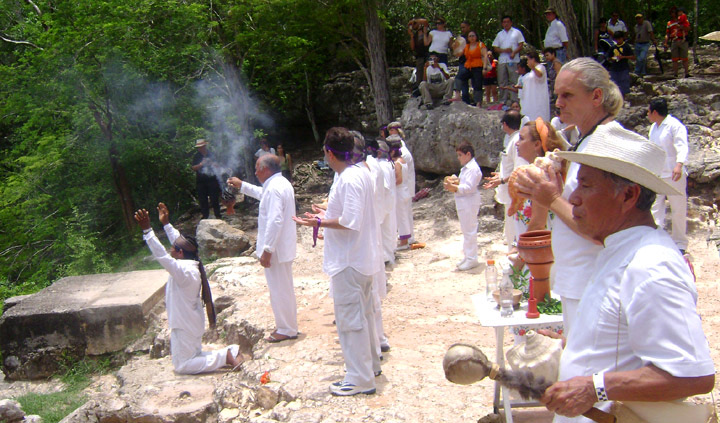
You may wish to participate in one of the many Mayan sacred ceremonies performed by JMen or Maya shamans and healers such as the Zumpul-che, a genuine ancient Mayan Sacred Cave and holistic sweat-bath ritual gear to prepare you to harmonize your inner-energy with the Cosmic influences of annual Spring Equinox. A Mayan celebration of union with Mother Earth and the Cosmos offered by the Mayan Elder Priests and Wiseman (Mayan Shamans) at the Sacred Ceremonial Site they keep within the Mayan Jungle Reserve at Hacienda Chichen Resort in Chichen Itza, Yucatan, Mexico. Participation requires prebooking and a fee donated directly to our Maya Foundation In Laakeech, NGO.
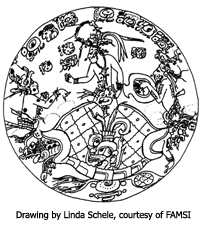
Maya history flows in cycles of rise and fall periods, of continuity and change; guided by a holistic religion that remains the foundation of their culture even today. The Maya vision of the universe is divided into multiple levels, above and below a flat Earth held by four Bacabs, (cardinal directions of north, south, east and west). The Sacred Tree of Life orCeiba is at the center of a complex communion of Celestial Gods and underworld, Kibalba, deities. The ancient Maya pantheon of gods and deities, was worshipped in multiple sacred ceremonies and offerings included even human sacrifices. Nobles and Rulers were believed to be descendants of the gods and their blood was the ideal sacrifice, either through personal bloodletting or the blood of royal captives; their names where represented with Mayan glyphs, their written language examples can be found here.
For those J-Men and Ix-Men Maya priests who continue practicing many of the ancient Maya traditions; the belief “that there is a direct cosmic influence on human lives” is at the core of their faith. Even today, these holly-men and high priests pay homage to their gods through holistic rituals and sacred ceremonies with up most reverence and faith. Hacienda Chichen supports and sponsors the Maya wise-men traditions; the owners have donated a portion of their land to create two active Sacred Mayan Ceremonial Sites.
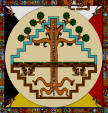
The Mayan Sacred Tree of Life is a Kapok tree generally referred to as "La Ceiba" in Yucatan and Guatemala, a Spanish common name for the Ceiba pentandra tree; this tree is also known as the Java cotton or Java kapok.
La Ceiba is sometimes referred simply as the Kapok tree in many parts of the world. This fascinating tropical tree is not only a revered sacred symbol in Maya mythology but an important element in the Mayan Cosmovision, even today.
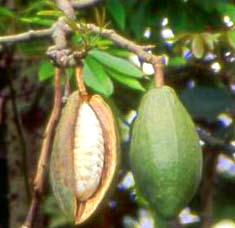
Kapok or Ceiba, is a tropical tree of the order Malvales and the family Malvaceae (once separated in the family Bombacaceae) native to Mexico, Central America and the Caribbean, northern South America, and (as the variety C. pentandra var. guineensis) to tropical west Africa. Adult trees produce several hundred 15 cm (6 in) seed pods; each pod contains many seeds surrounded by a fluffy, cotton-like yellowish fiber that is a mix of lignin and cellulose. The fiber obtained from these treesseed pods, is called in Maya “pochote” and was used by the ancient Mayan for various life comforts including clothes. An adult Ceiba tree will normally grow 60-70 m (200-230 ft) tall and has a very substantial trunk up to 3 m (10 ft) in diameter with buttresses. The trunk and many of the larger branches are densely crowded with very large, robust simple thorns, especially when young. The leaves are compound of 5 to 9 leaflets, each up to 20 cm (8 in) and palm like. To read full details click here.
Maya Wiseman or J-Men celebrate even today a highly respected sacred ceremony named: Ya’axche’: this ceremony represents the connection between Heaven, Earth, Man, and the Underworld for the Maya. Any Sacred Ceremonial Site will have this ceremony performed prior to its full service to the Maya community traditions. In Chichen Itza, such ceremony was celebrated by the J-Men in 2007 when the Hacienda Chichen owners donated a vast portion of their private Maya Jungle Reserve to the Mayan Healers and Priests to continue their Spiritual Mayan traditions in the manner their ancestors taught them. Since then, this sacred site has served as the grounds of many Mayan holistic rituals and sacred mystical ceremonies.
The Ceiba Tree of Life plays an important central part at each Mayan Wedding Ceremony and in other Mayan holistic rituals as well as in many Mayan mythological legends still belief by the Mayan rural people to be part of supernatural dark energies in the form of demons and legendary beings, such as is the case of theIx Tabay or X'Tabay.
In Chichen Itza, Yucatan, Mexico, Hacienda Chichen has committed to protect the flora (plants) and fauna (animals) living in its private Maya Jungle Reserve and Neo-tropical forest where many Ceibas grow tall and new have been planted to reforest a vast area of land. You can enjoy reading and observing a few photos of the many indigenous animals (Yucatan endemic species) living there, such as: mammals,birds,reptiles (iguanas), butterflies, bees, spiders, mantis and other insects and creatures.
Mayan mythology portrays the Gods first creating “Man” out of clay, but this creature was not satisfying to them, so clay-man dissolved and crumbled away. The Mayan gods then created a being of wood which had no soul; thus, this “wood-manly-being” had no recollection of its creators; so the gods had it burn. Then the Maya Gods and Deities chose to form a third kind of man, this time from corn and they were pleased; therefore, ancient Mayas believed, as many do today, to be the son’s of maize.
Even today, maize or corn continues to be the cornerstone of the Maya people's diet and a sacred nourishing element for Gods and humankind. Maya mythology dictates that the sons’ of maize had to perform sacrifices to their gods to please them; thus, ancient Mayan created their city-states and they began blood sacrifices and rituals including the human sacrifice to their gods. Today, Maya priests do not perform blood sacrifices to their Gods and deities; instead, their Mayan sacred ceremonies and rituals incorporate the sacred natural elements of fire, wind, water, and earth, plus new maize, wild honey (Bacabssymbolic presence), báalche, copal, raw sea salt, essential oils, etc.
Maya High Priests and Elder Maya Holistic Healers (Aj Men, J-Men, J'Men, Ix Men) continue teaching today many young Mayans their healing arts and spiritual traditions in an effort to preserve and share their ancestor’s traditions and wisdom. On September each year, the KUCH KAAB Y'EETEL J'MEN MAAYA'OB, A.C., an elder Mayan Wiseman association headed by Don Valerio Canché Yah, celebrates their KA’A MOLAYIL J-MENO’OB YÉETEL TS’AKYAJO’OB MAAYA’OB or Annual Mayan Wiseman Symposium in an effort to keep the Mayan healing traditions alive and to encourage young adults with the gift of healing to continue serving their communities. The Maya Foundation In Laakeech and Hacienda Chichen actively sponsor such activities as part of their commitment to preserve the Mayan cultural and holistic traditions.
The Spanish Conquest, in the 16th century during the Colonial Era of Yucatan, destroyed most of the Maya people and their civilization. War, diseases, and Catholicism eliminated not only the Maya socio-political system, but their religion, written records, codex and scripts, along with their wealth and freedom. Some Mayan people survived; but the vast Mayan civilization records, the Mayan Cosmo-vision (deities, rituals, cosmology), mathematical achievements and history were burned by the Catholic Inquisition and lost forever.
With time, most Maya spiritual practices of today, including in Yucatan, incorporate elements of Catholicism. Despite the pressures of modern world views, economic devastation, the vast Catholic faith infiltration and political upheavals, many Maya Elders and J-Men continue their ancient beliefs and sacred rituals in their purest form invoking their Gods in un-mixed Maya language; these spiritual ceremonies have been kept with reverence, performed with up most veneration, and taught with care by the Maya Priests and Elder Healers of KUCH KAAB Y'EETEL J-MEN MAAYA'OB, A.C a non-profit organization under the direction of Don Valerio Canché Yah; Maya Elders and “safe-keepers” of Maya knowledge and wisdom, they honor their ancestors’ beliefs, gods, deities, the Maya Cosmo-vision, and a true Mayan holistic understanding of life. Their commitment to safe-keep their ancestors’ cultural heritage enriches our world and understanding of humankind.
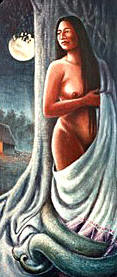
The Ix Tabay or X'TabayMayan Legend - (Pronounce as "sch-tabai") is a fallen ancient Mayan goddess, before Christianity she wasreferred to as "Ixtab" the goddess of suicide. The Ix Tabay legend remains in the Maya communities of today as an "existing and very real deadly spirit of the night. Such spirit takes the form of an extremely attractive woman, incredibly sensuous and beautiful, that appears to solitary males especially during full moon. She always awaits the male near a Ceiba tree trunk; where she seats and combs with sensuous delicate strokes her long dark beautiful hair, so long that it falls beyond her hips. This sensual being awaits and calls upon the poor male soul, whether he is drunk or not, old or young she has no preference; her voice is so inviting, her body so sensual, and her eyes so fascinating that the men have a hard time resisting her advances; most of them give in to her seduction, as she moves smiling and joyfully giggling into the dark forest.
A sensual game of hide and seek is played for a few minutes by the male and this deceitful dark spirit with increasing tones of sexuality until the X'Tabay lets him embrace her; at that moment, her sensual game turns into deadly terror for the poor male as he tries in vain to free himself from her arms now in the form of thorny branches and her face full of spines, hate, and a vivid desire to devour him alive.
Few males have encounter the X'tabay and have lived to tell their story; most of them are found dead next morning at the trunk or roots of the Ceiba tree, wrapped with thorny branches and terror showing in their distorted faces. The X'Tabay is the Queen Goddess of Suicide in the Pantheon of ancient Mayan gods, deities and the underworld demons. The Maya culture is unique in its inclusion of a goddess of suicide in its embracing deadly deities and gods.
Back to Top
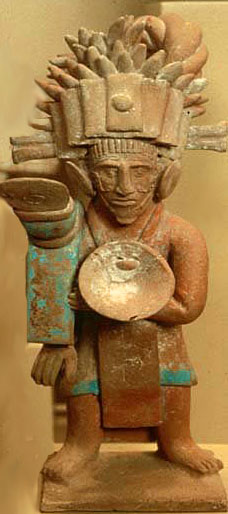
Alux, Aluxes or Aluxo'ob - (pronounced " a'lush " singular, " a'lushes or alush' ob " plural). Mayan rural people, all over Yucatan and Guatemala, will tell you stories of their personal encounters with an Alux or with a group of Aluxes, mythological Mayan spirits that live in the Mayan jungle, forest and near milpas where Mayan farmers grow their crops; Aluxes are invisible wild-energies that protect the Mayan jungles and love to interact with humans for they enjoy honey treats and sweet offerings. These Mayan Alux' ob or Aluxes gladly take form of small dwarfs, about knee-high, resembling miniature ancient Maya people dressed with ancient clothing and attires. These energetic invisible guardians of the forest, love to mimic a human spirit; thus, they can mirror the dark or light essence of a person, communicate in a manner to frighten a human or to bring joy and loving protection, all depending on the human's personal inner-self and respect for Nature and the Mayan Spiritual Realm.
Aluxes or Aluxo' ob may choose to become a "guardian Mayan angel" to a person or family, or congregate to help a farmer as much as to make his life miserable. These supernatural creatures are pure energy spirits, similar to the idea of Chi in the Orient; thus, dualistic in nature. They live in Mayan caves, cenotes, forest clusters and near towns. Mayan people bring offering to them before they venture into the forest or start their milpa farming. Tradition holds that aluxob are generally invisible but are able to assume physical form for purposes of communicating with and frightening humans as well as to congregate together.
Other cultures' mythologies include similar entities in their traditions such as the Celtic Leprechaun or the Forest Fairies in Europe. Mayan farmers are known to build mini-huts in their milpas and offer them to this forest guardians as a token of gratitude for their helping the farmer yield a successful maize crop, making rain come to be, or patrolling the farmer's field at night making sure no predator or thieves goes unpunished. Aluxes are known to treat humans with the same energy that humans treats them, and the treatment is in "seven years cycles" ! So, they can be helpful protecting a person or a nightmare to live with them if a human does not respect their existence, makes fun of those that belief in them, or brakes an offering promise to them.
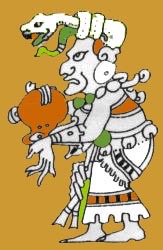
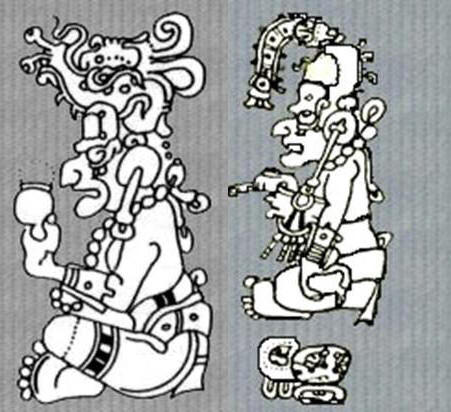
Maya Scripter employed their own sense of artistic style when depicting their gods, as shown in the images of Itzamná (left above ) and of Ix Chel(right). Learn more about Maya Gods.
Various Maya scholars speak of a single "Supreme Lord and God" with a court of gods and deities; yet, a few others scholars say it is the God Itzamná, the inventor of writing and patron of the arts and sciences, who deserves such titled. Still, Mayan mystics and holistic healers agree that the Supreme God has a non-spoken or written name for it is so sacred humans are not to use it in vain; and that Itzamná is the "lower supreme god" who has the power to open the Spirit World Portal to J-Men and Ix-Men, male & female healers alike.
Itzamná’s wife, Ix Chel is the ancient Goddess of the Moon, weaving, medicine, fertility and childbirth. She is a goddess often depicted pouring water down, symbol of life, from a clay pot; or, seating in the moon holding a rabbit Scripter. Some scholars feel she is the First Mother and assign the role of First Father to Hun Nal Ye the Maize God and Gukumatzthe Plumed or Feathered Serpent.
DID YOU KNOW: The Popol Vuh speaks of the First Mother Ix Chel and First Father Hun Nal Ye, as the Creator Couple whose offspring are all the other gods. She was born six years before the First Father, also known as Junab K’uj the God of Maize, who is responsible creating the cosmos and mankind as we know. For more about Maya Gods...
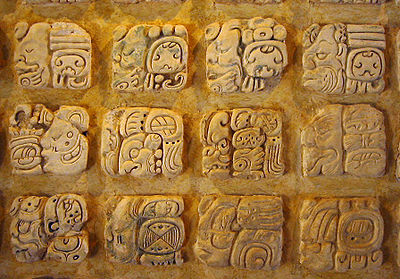
Since 250 AD until the end of the Classic Maya period, ancient Maya created a sophisticated civilization that included impressive achievements such as the Mayan phonetic writing system, political and economic organization, majestic urban architecture, courtly society, historical recording, mathematical system, and the Mayan understanding of the Universe among other impressive scientific knowledge unmatched by anywhere other ancient civilization. Classic Mayan scripter developed the Mayan written language with artistic hieroglyphs or word-signs known today as Mayan glyphs ( each glyph was fundamentally logographic, compounding a series of phonetic syllables, suffixes and prefixes, to represent each Mayan word within a phrase).
"Maya" is a complete language, not a dialect, with over thirty different Mayan speaking dialects found today throughout the Mayan region in Meso-America. Bishop Diego de Landa, during Yucatan's Colonial times ordered the collection and destruction of all written Maya books and codices. Landa was fascinated with the Mayan language and did create a Latin orthography of the Maya language spoken in Yucatan; his orthographic work has helped today's scholars decipher many glyphs.
Ancient Mayan writing system included visual symbolic Mayan glyphs to represent whole words, as a jaguar head for the Maya word "Balam" (jaguar) and to represent important data such as Mayan royal linage and titles (emblem glyphs), significant dates, events, seals, etc.
Ancient hieroglyphic script is closely related to some of today's spoken Mayan languages: Chorti Maya (spoken in Honduras near Copan); Yucatec or Yukatek Maya (spoken in Yucatan's Peninsula); and, Chol Maya (spoken in Chiapas near Palenque). One of the largest Mayan linguistic groups speaks Yucatec Maya.
Contemporary Mayan language: Nowadays Mayanist scholars have created a linguistic fusion to write Yucatec Maya language still widely spoken in Yucatan by native Mayan people. Contemporary Mayan language is written today by using Landa's Latin orthographic alphabet and phonetic format. The following phrases are to example such Mayan-Latin contemporary linguistic writing fusion:
Maya phrase: "Bix a belex?" (pronounced: Beesh ah behlehsh?)
English meaning: "How are you?"
Maya phrase: "Maloob, Yum botic" (pronounced:Mah-lohb, Yoom boh-teek)
English meaning: "I am fine, thank you"
The Nature of Ancient Mayan Written Language
A brief introduction by Mayanist scholar Dr. David Stuard
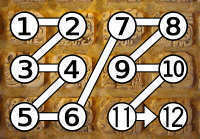
Anyone glancing at a Maya inscriptions would be immediately struck by the sheer complexity of the visual forms of the script itself -- the "look" of the Maya script is in fact difficult to compare with any other. A text is typically arranged in a grid-like fashion, or by a linear arrangement of the same square blocks that are a basic formal unit of the system. Each block is composed of one or more signs, most of which possessed a strong pictorial quality throughout their history. Human and animal heads, body parts, and other objects of everyday life -- all these symbolic pictured things can be recognized in most Mayan glyph inscriptions. However, it is a mistake to consider Maya writing as simple "picture writing," for nothing could be farther from the truth.
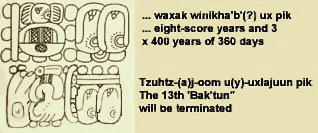
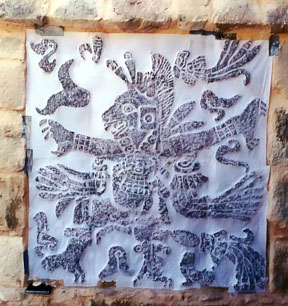
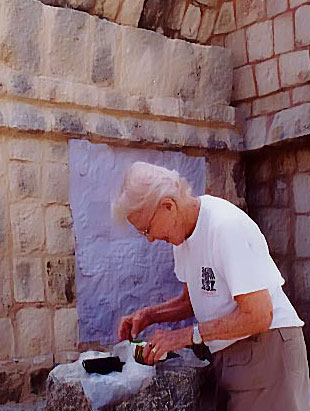
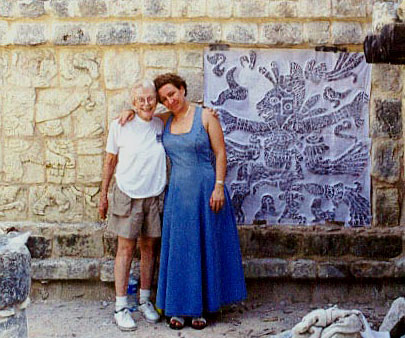
The last Winter Equinox of the 13th Bak'tun Mayan Calendar cycle ending in Dicember 2012 is recorded as a Cosmic Alignment in a Mayan Classic period inscription found at Mayan monument #6, in the archaeological site of Tortuguero Chiapas, Mexico. Such Mayan glyph reliefs narrated by Maya king B'ahlam Ajaw has created many expectations about the end of the world. Sven Gronemeyer from University of Bonn, Germany, traced the above Mayan glyphs and Dr. David Stuart from University of Texas, USA, translated its text into English. The text speaks about the Ending time in the 13th Bak'tun (our year 2012) such text has created many expectations for 2012.
Ancient Maya hieroglyphs represent a complex logographic writing language system, meaning that it was above all phonetic. Every Maya sign corresponds to a word or a phonetic syllable, and thus was capable of accurately representing any spoken utterance. Word signs are the simplest type, where a character might represent a macaw head and be read Mo', "macaw." Hundreds of such signs are known. More complicated are the syllabic elements, which were combined in various ways to spell words. Syllabic signs may well be pictorial as well (bird heads, hands, etc.) but the image is not necessarily an indicator of meaning in such cases. Thus, the syllables k'u-k'u spell k'uk', "quetzal," and the sequence la-ka-ma spells lakam, "flag, banner." Words such as these were commonly spelled with word signs as well, showing that there existed an inherent optionally to the script. Scribes constantly had to choose among the large repertoire of signs (some 800 in all) when composing their texts. To make matters even more complicated, a single syllable or word sign could have several substitutes or "allograph" -- signs that graphically very different but functionally equivalent. For example, the syllable na could be rendered by five distinct signs. One can see why the decipherment has been a long and arduous process over the years
If you are interested in learning more about ancient Mayan written language, we recommend reading The Maya Glyphs, Second Edition by Michael Coe and Mark Van Stone (Thames & Hudson 2005); to hear how the Maya language is spoken and view how it is phonetically written with examples of Spoken Mayan glyphs, a great collection of Mayan glyphs with their English meaning and correct pronunciation by Professor Stephen Houston from Brown University.
We hope you find our Online Volunteer Magazine's articles interesting and full of learning fun. Yucatan Adventure welcomes article, news, travel contributions, and ideas on how to support the Maya Foundation In Laakeech A.C. efforts to help the Mayan Communities nearby Chichen Itza, Yucatan, Mexico.
This article is a courtesy of the following non-profit organizations:
Maya Foundation In Laakeech A.C.
The Elder Mayan Wiseman Association KUCH KAAB Y'EETEL J'MEN MAAYA'OB, A.C.
Please take a minute to visit our nominated entry at Geotourism Challenge for Sustaining the Future of Destinations, our social Eco-Cultural work
is part of the Maya Foundation In Laakeech A.C. social sustainable work and Hacienda Chichen.
This unique geo-project was sponsored by National Geographic and Ashoka's Changemakers.
Yucatan Adventure welcomes article and travel contributions to support the Maya Foundation In Laakeech A.C. efforts to help the Mayan Communities nearby Chichen Itza, Yucatan, Mexico.





.jpg)