Yucatan Adventure proudly supports the social vision of
THE MAYA FOUNDATION
IN LÁAKEECH
For more information on
how to join our Volunteer Team and/or support us, please contact us
via
email
or pledge your help !
Sponsored Site:
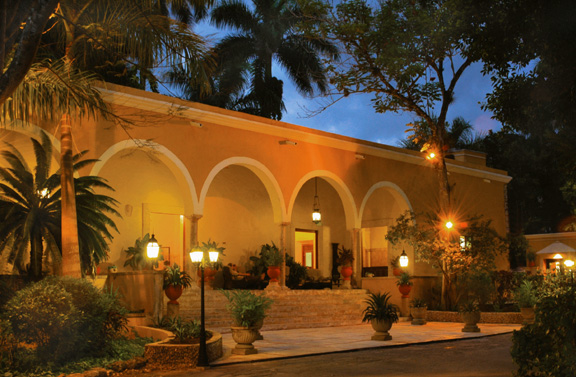
Stay in Hacienda Chichen:
the finest Green Hotel & Spa
in Yucatan, Mexico.
Mayan Calendars
Ancient Maya discovered two fundamental ideas in mathematics and
used them in their numeric system: the positional value and the
concept of zero as a numeric unit.
300 years after the Maya accomplished their impressive numeric
system, did the Hindu ancient civilization was able to acquire such
important numeric understanding.
DID YOU KNOW:
The Elder J-Men
or Mayan Shamans
and Wiseman
Healers suggest
that if you
visit
Chichen Itza
during this
year, you
participate in
one of their
mystical
KAY NIKTE'
ceremony to
renew your
intimate
connection with
Life, Moon
and Cosmos.
(see dates)
The
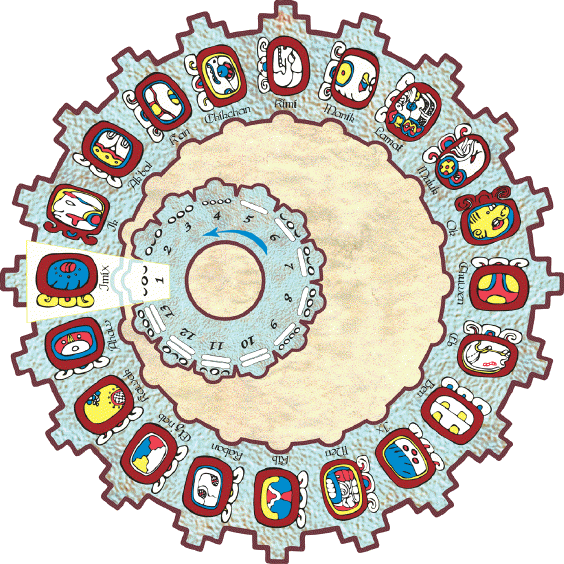
Mayan solar calendar of 365 days depicted here is called "Haab;”
it is divided into 18 months of 20 days, each with a period of 5
days left over at the end of the year. This short 5 day month is
called “Uayeb,” the resting of the year.
The most
important calendar cycle for the Maya is
Tzolkin, a ritual calendar of 260 days also known as the
Sacred Almanac and J'Men Elder Mayan Priests (Shamans) continue
using its count to celebrate their
Mayan sacred rituals and ceremonies.It
is composed of 13 months, each with 20 days.Every day in
the 260 day calendar has a unique corresponding position in time
as well as in the “Haab” or the solar 360 + 5 day Maya
calendar. Each day’s position in the calendars only
repeats itself every 52 solar years.
A cycle of 52 solar years, called the Sacred Calendar Round
intermeshes with both Haab and
Tzolkin
calendars to form a calendar system of the
Maya’s Cosmo-vision
and time. There is one more calendar, the Long Count, a linear
calendar interpretation of time that the Maya perfected during the 1st
millennium A.D.
THE MAYA LONG COUNT: The Maya calculated dates millions of
years in the past and the future for ritual purposes with the use of
their “Long Count,” or date calendar, which records the total number
of days that have elapsed since their zero day 0.0.0.0.0 that
can be correlated to August 2nd, 3114 B.C. in our
Gregorian calendar. The present Haab calendar cycle will end
on 13.0.0.0.0 or December 21st, 2012 A.D. in our
Gregorian calendar which will mark the winter equinox. The
slow wobbling of the earth's polar axis causes the precession of
equinoxes, also known today as the Platonic Year, this was well
known by ancient Maya timekeepers, or sky-watchers, and played an
important part in ancient Mayan
gods,
sacred ceremonies, Cosmo-vision andMayan
mythology.
December 21st, 2012 during the Winter Solstice a calendar
cycle concluded for the Haab and Maya Long Count calendar
(the Maya recorded multiple calendars interlocking
time
/ space cycles and the cosmos).
Mayan
mythology
foretells the creation story of the Hero Twins and the end of the
present Haab (solar year) which interlock with the end of the Long
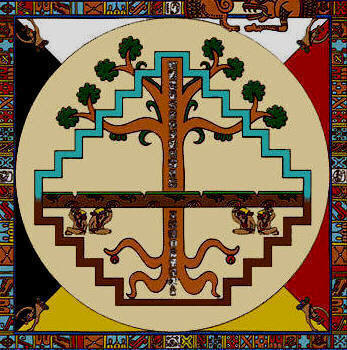
Count calendar cycle; this rare cosmic event, the cross formed by
the intersecting Milky Way and the plane of the ecliptic path of our
solar system, was symbolized with a Ceiba
Sacred Tree of Lifeby ancient
Maya and marked the end of a cycle and the beginning of a new era. The long count
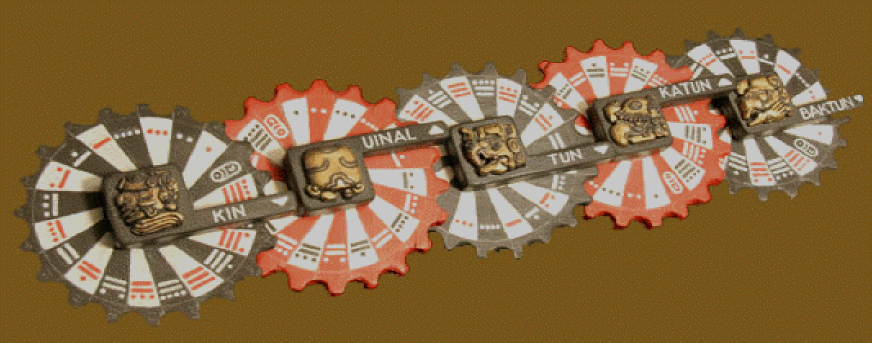
is based on the number 20 and days are referred to as kin.
·
A day is called “kin”
·
Each set of 20 kin (days) is called uinal
·
Each set of 360 days is known as tun
·
Each set of 20 tuns (almost 20 years) is known as katun
·
Each set of 20 katuns (almost 400 years) is known as baktun
Name and meaning of each "Kin" or Mayan 20
Days:
English Meaning:
Monkey
Broon
Reed
Jaguar
Bird / Eagle
Owl
Force
Knife / Sacrifice
Thunder / Rain
Lord / Wiseman
English Meaning:
Sea Dragon / Water
Air / Life
Night
Corn
Serpent
Death
Deer / Grasp
Rabbit
Rain
Dog
Mayan
Name:
Chuen
Eb
Ben
Ix
Men
Cib
Caban
Etz'nab
Cauac
Ahau
Mayan
Name:
Imix
Ik
Akbal
Kan
Chic' chan
Cimi
Manik
Lamat
Muluc
Oc
Day #
10
11
12
13
14
15
16
17
18
19
Day #
0
1
2
3
4
5
6
7
8
9
You may wish to learn how to find current dates in any of the Mayan
Calendars
at the
Maya Skies interactive page by Chabot Space Center, USA
Long count dates are inscribed on many ancient
Maya monuments,
ceremonial vessels and codex. The count is expressed in a
sequence like this one 9.13.0.5.2 which reads: 9 baktuns, 13
baktuns, 0 tuns, 5 uinals, 2 kins. NOTE: original Maya numerical
reading format goes from right to left numbers as shown in the Mayan
wheels of time:
.
OTHER
MAYA
CALENDAR FACTS:
We concluded the Mayan Male Energy Cycle on November 11, 2011
(11.11.11) with J'Men Jose Tamay, a Maya shaman, closing the cycle
with a Saka Maya Ceremony in Chichen Itza, Yucatan, Mexico.
We will welcome the new energy cycle dedicated to the female energy
and rebirth cycle on December 22nd. 2011 at the start of the Winter
Solstice with the Maya female healers, known as Ix'Men
activating the New Light Cycle and Wisdom of Mother Earth with a
ceremony to Ix'Chel the supreme Maya goddess. For the Maya Healers,
2012 start the first cycle of renewal for the female energy in our
planet's collective consciousness, a gentler energy that will guide
us to become more aware of our intertwined
multidimensional existence and begin the process to awaken the
collective mind to reconnect with the Cosmos with a new
understanding
(Maya
Cosmo-vision).
To help us prepare for this new Light Cycle, the Maya Female Shamans
and Healers will take the caring lead throughout this year;s Maya
Ceremonies in
Chichen Itza
Sacred Maya Ceremonial Site at Hacienda Chichen.
DID YOU KNOW: Dresden Mayan Codex:
In 1519,
Hernan Cortez navigated the Yucatan coastline during the his
conquest travels of the New world. It is assumed that the
Dresden Mayan Codex was one of the many treasures and gifts he
sent to the King of Spain; such codex, experts agree today,
originally came from
Chichen Itza during the
post-classical Maya period, in 1250 A. C. This beautifully
crafted ancient Mayan manuscript has been an important key for the
study and understanding of
Mayan Gods, numbers, hieroglyphs
and writing. This piece of information is of utmost importance
to today's J-Men and Mayan Senior Wiseman since the codex contains
important description of the
Mayan Cosmo-vision, holistic
understanding of mankind, the planet, gods, and astronomical events.
The Dresden Codex also contains a
Mayan ceremonial calendar for the different
Mayan
gods, tables of solar and lunar eclipses, calculations of
the planet movements, especially Venus and Mars, and many
Mayan cultural
traditions that are all part of Yaxkin Spa
Mayan
Holistic Healing Care and purification ceremonies.
This article is a courtesy of the
following non-profit organizations:
Maya
Founation In Laakeech A.C. and the
Elder Mayan Wiseman Association
KUCH KAAB Y'EETEL J'MEN MAAYA'OB, A.C.
HACIENDA CHICHEN RESORT AND YAXKIN SPA
May and June 2014 Special Offer !! Book
Two Nights and Stay a Third Night FREE.
This is a
non-refundable offer, limited
to new prepaid online bookings.
Book Now
These unique Mayan Eco-Cultural Wellness Getaway experiences were
designed with the support and help of the Mayan Elder Healers and
Wiseman, and include mystical personal encounters with the Mayan
Cosmo-vision, traditions, Mayan purification rituals, Green Spa
Wellness personal care, holistic living and organic healthy meals.
HAAB SOLAR CALENDAR ECO-CULTURAL
VACATION PACKAGES
AVAILABLE FOR INDIVIDUAL, COUPLES, WEDDINGS AND SPECIAL GROUPS.
For details contact:
Hacienda Chichen Spa Resort
We hope you find our
Online Volunteer Magazine's articles interesting and full of
learning fun. Yucatan Adventure welcomes article, news, travel
contributions, and ideas on how to support the Maya Foundation In
Laakeech A.C. efforts to help the Mayan Communities nearby Chichen
Itza, Yucatan, Mexico.
Helps us Help!
We hope you find our Online Volunteer Magazine's articles
interesting and full of learning fun. Yucatan Adventure
welcomes article, news, travel contributions, and genius ideas on
how to support the Maya Foundation In Laakeech A.C. efforts to help
the Mayan Communities nearby Chichen Itza.