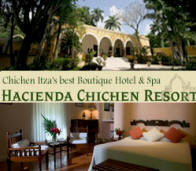
 DID YOU KNOW: During Jean Charlot's participation in the Carnegie Institute's Maya Expedition during the 1920s; he and his colleagues built their cottages at the Hacienda Chichen, now Chichen Itza's hotels top choice offers you his lovely cottage with four ample rooms named in his honor; all fully green eco-friendly remodeled recently. For more information about Jean Charlot and the Hacienda Chichen, please click here.
Jean Charlot Brief Biography:
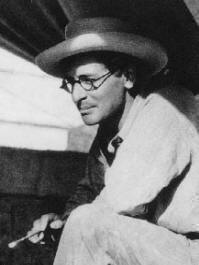
A French-Mexican artist, illustrator and muralist, writer and archaeologist, Jean Charlot was born in France and attended the National School of Fine Arts in Paris. In 1921, Charlot and his widowed mother immigrated to Mexico where his mother’s family had lived for several generations. Charlot played a major role in the post-revolutionary florescence of Mexican art, becoming close friends of many leading muralists: José Clemente Orozco, David Alfaro Siqueiros, Fernando Leal and Xavier Guerrero. He began his mural painting as an assistant to Diego Rivera. It is accepted that Charlot’s knowledge of fresco painting was critical in the development of the techniques favored by the leading muralists. Charlot’s own mural, “The Massacre in the [Aztec] Main Temple,” painted on the walls of the Escuela Nacional Preparatoria is usually considered the Mexican mural movement’s first true fresco.
Charlot devoted much of his artistic energy producing prints, particularly woodcuts. He carried with him from France his devotion to popular folk art (the Images d’Epinal), and early recognized the importance of Mexican satirical pre-revolutionary printmaker José Guadalupe Posada. Throughout Charlot’s career, he stressed his commitment to creating popular, reproducible, and even useful art for the people.
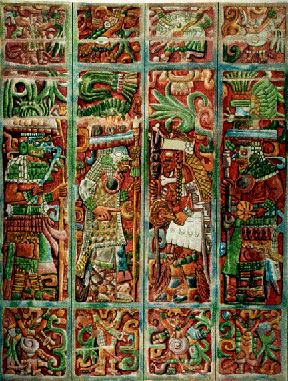 While in Mexico, he wrote many articles, collaborated closely with writer Anita Brenner and a dear friend to photographer E. Weston.
His art style strongly reflected the Mayan Pre-Columbian sculptural traditions of Mexico, their ties to the earth and stress on geometric forms and volume. From 1926 through 1928, Charlot lived and worked at Hacienda Chichen in Chichen Itza, Yucatan, Mexico, as an expedition artist for the Carnegie Institution of Washington’s excavations at Chichén Itzá. As a co-author of The Temple of the Warriors report he gained fame as “the painter turned archaeologist.” Today, some of his artwork can be enjoyed at the hotel Hacienda Chichen Resort's main lobby.
In fall of 1928, Charlot moved to New York to seek new career opportunities; however Mexico remained the prime inspiration for the subject and style of his art. In the summer of 1931, he returned to Mexico where he met his future wife Zohmah Day. In 1945, he received a Guggenheim fellowship to return to Mexico to write his masterwork, The Mexican Mural Renaissance: 1920-1925. In 1949, he was invited to join the faculty of the University of Hawai’I as teacher and artist in residence. He, his wife and four children, remained at the university until his death in 1979. His Mexican experience, now transformed into Polynesian settings, continued to echo in his newly created murals, paintings and prints.
Charlot, Jean. The Mexican Mural Renaissance, 1920-1925. New Haven, CT:
Yale University Press, 1963.
Charlot, Jean. An Artist on Art. Collected Essays of Jean Charlot. Honolulu:
University Press of Hawaii, 1972.
Klobe, Thomas, ed. Jean Charlot: A Retrospective. Honolulu: University of Hawai’i Art Gallery, 1990.
Koprivitza, Milena, and Blanca Garduño Pulido, eds. México in la obra de Jean
Charlot. México: Consejo Nacional para la Cultura y las Artes, 1994.
McVicker, Donald. “El pintor convertido en arqueólogo.” In Koprivitza and Garduño Pulido, eds., pp. 57-72.
Morse, Peter. Jean Charlot's Prints: A Catalogue Raisonné. Honolulu: The
University Press of Hawai’i and the Jean Charlot Foundation, 1976.
Donald McVicker recently retired as Professor of Anthropology/International Studies, North Central College, Naperville, IL. He received his Ph.D. in Anthropology from the University of Chicago. He has worked extensively in Mexico and has specialized in the archaeology and art history, particularly on the analysis of pre-Columbian murals. Dr. McVicker is also known for his research on the history of anthropology. The study of Jean Charlot's work for the Carnegie Institution's excavations at Chichén Itzá has provided him with the opportunity to combine his two primary professional interests.
Contact us now to request articles you would like to read in our website
If you would like to find out more on Charlot & his role in recording Mayan art, please visit The Jean Charlot Foundation.
Hacienda Chichen's Jean Charlot Cottage is embraced by beautiful flora and fauna in Chichen Itza, Yucatan, Mexico. Plan to visit and enjoy the magical ambiance of this enchanting green boutique hotel the best among Yucatan Haciendas and Chichen Itza hotels !
June 2007
Updated April 2016