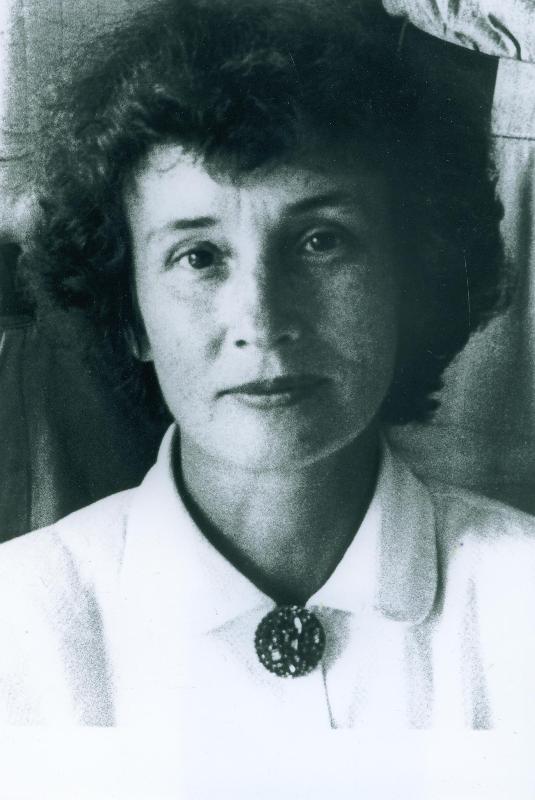
Tatiana
Proskouriakoff (1909-1985) was one of the leading 20th century
interpreters of Maya art, architecture, and hieroglyphs. During a period
when Mesoamerican archaeology was almost exclusively a profession for men of
means, she sought new approaches to old questions about the ancient Maya,
challenging long established views of the
Maya ancient civilization. Over the
course of her fifty-year career, Tania’s field work, research, and publications
eventually earned the respect of her colleagues and the highest accolades given
in her profession.
From her earliest years in Siberia , Tania was nurtured and encouraged
by her parents — one a chemist, the other a physician — who
discovered she could read fluently by the age of three. She
demonstrated a talent for drawing and received lessons in art and
watercolor. She later used these skills in the engineering school
of Pennsylvania State University where she studied for a degree in
architecture. In 1936, while sketching at the University of Pennsylvania
Museum, she came to the attention of Linton Satterthwaite, director of a
major Maya archaeological project. He appreciated the detail and
delicacy of her drawings and enlisted her to join his next expedition to
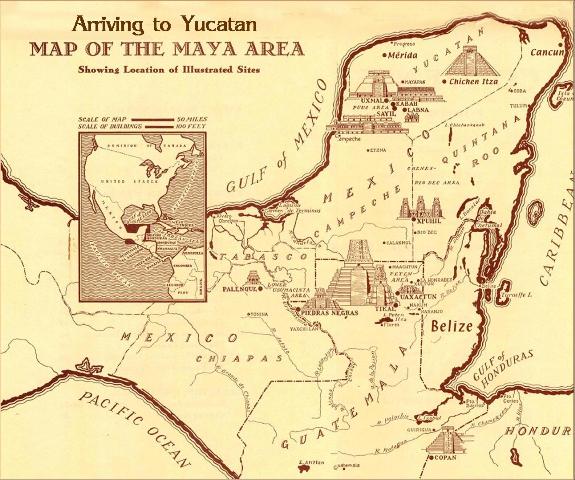
Piedras Negras along the Usumacinta River on the border between Mexico
and Guatemala. This marked the beginning of her life long passion
for the ancient Maya.
In 1940, Tania joined Sylvanus Morley and his wife in Mexico
to work at the ruins of Chichen Itza, Uxmal, and Kabah. Archaeologist
Morley, head of the First Mayan Explorers
Expedition with the Carnegie Institution of Washington, had conceived
of a project for which he felt Tania was particularly well suited.
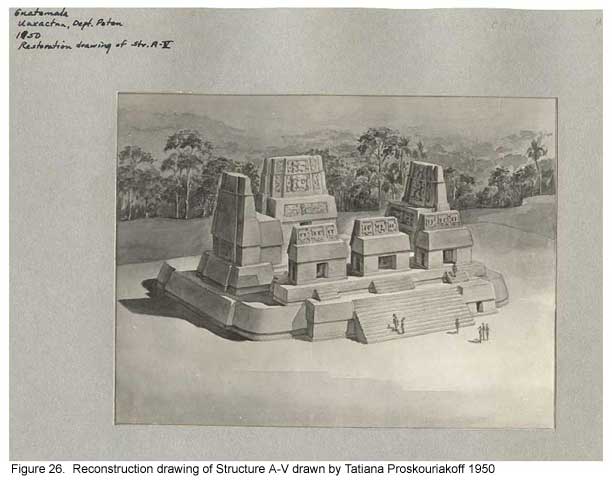
He believed that a publication of drawings, which would reconstruct the
majestic architecture of important
Maya archaeological sites, would
build world-wide interest in the region. He was correct.
Tania’s completed work, An Album of Maya Architecture,
first published in 1946, is still in print today.
She went on to make significant contributions in this field, at times
facing self-doubt and sacrificing personal happiness to her career.
In 1962, she received the Alfred Vincent Kidder Award for Eminence in
the Field of American Archaeology, in part for her article, “Historical
Implications of a Pattern of Dates at Piedras Negras , Guatemala ,”
published in American Antiquity in 1960. In this, she
put forth her historical hypothesis that glyphic inscriptions found on
Maya stone monuments dealt with key events in the lives of specific
rulers by identifying glyphs for birth and accession. This article
pointed the way for scholars’ breathtaking break-through that have
since occurred in deciphering Maya texts. In 1998, Tania’s ashes
were buried by a group of international archaeologists in a touching
ceremony at the site that marked the beginning and the pinnacle of her
career – Piedras Negras.
Tatiana loved her time at
Hacienda Chichen,
Chichen Itza, Yucatan,
Mexico; she returned to her enchanting Jungle Cottage at the Hacienda many
times during her lifetime and marvel at the majestic beauty of the
Maya temples,
and the amazing
flora
and
fauna
of
the Hacienda's land.