|
Yucatan's
Bird-watching and Nature Tours
Hacienda Chichen Resort
Yucatan Bird Guide and Photos

Bird-Watching Paradise and Eco-Cultural
Destination:
Yucatan's Ecotourism and Responsible Sustainable Tourism at its Best!
At
the
Hacienda Chichen's Bird Refuge and Maya Jungle Reserve in
Chichen Itza, Yucatan, Mexico, guests and visitors alike marvel at
the beauty of Mother Nature's wildlife. Take a visual tour now of our
Maya flora
(plants)
and
Maya fauna
(animals) and imagine what a great
vacation you can enjoy at Hacienda Chichen, which is Yucatan's ideal
bird-watching for both aficionado and professional birders.
The bellow "Full Bird List" is grouped in a manner that most bird lovers will
understand rather than in a scientific family format;
should
you
observe at the
Hacienda
Chichen Resort an additional family or species not
mentioned here, please
contact us to include it;
plus, if you can send your photo it will be great, thanks!
Yucatan Bird Guide: list of birds found at
Hacienda Chichen
Chichen Itza, Yucatan, Mexico
Anis and Cuckoos
Bunting Birds Cardinals &
Grosbeak
Currasows and
Guans Doves and Pigeon
Egret
Euphonia and Finches
Falcons & Caracaras
Flycatchers
Galliforms
Crackles and
Cowbirds
Gnatcatchers and
Grassquits
Hawks
and Goatsucker Birds
Humming Birds
Jay Birds
Motmot Birds
Mocking
Birds
Orioles
Owl Birds
Parrots
Quails
Swallows and
Thrushes
Tanagers
Tityra and Bacaard
Tucans
Turkey
Trogons
Vireos
Warblers
Woodpeckers and Woodcreepers
Yucatan Endemic Birds Black-birds
ID
 Ani and Cuckoos: Ani and Cuckoos:
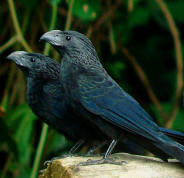
Ani Groove-billed,
Crotophaga
sulcirostris,
called "Chic Bul" or "Ch'ikbu'ul" in Maya, is a tropical black bird in the cuckoo
family that resides at Hacienda Chichen Bird Refuge most of the year. It has
black-shiny plumage, deep horizontal grooves along its strong wide
beak, strong mandible and a really long long tail. Normally, the Ani
Groove-billed is observed in small pair groups in open pastures and
orchards. Territorial, the group feeds mainly of insects, seeds, and
round forager. Ani Groove-billed lay their eggs in one communal nest
placing it in tall trees with all group members incubating the eggs and
caring for the young. Order: Cuculiformes / Family Cuculidae.
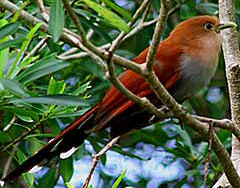
Squirrel
Cuckoo,
Piaya cayana, called "Kip Cho" in Maya, cayana (Kip Cho in Maya), a rather large bird averaging 46 cm long. A shy bird
is found in woodlands and semi-open jungle hedges. Squirrel Cuckoo birds fly only short distances, leaping
from branch to branch feeding on large insects such
as spiders, caterpillars, wasps, and sometimes fruit.
Squirrel Cuckoo plumage has a cinnamon or chestnut
upperparts covering the top head, then paler on the
throat with an almost pink tone. Its lower breast and belly are grayish. Squirrel Cuckoo's long tail feathers
have black with white band-like tips. The bill is lime
and the iris is red.
These beautiful birds are fairly large in size
and their call has
sharp "kip! weeuu sounds with long wheeps whistles.
Females lay 2 or 3 eggs on
twit-leaves high nests.
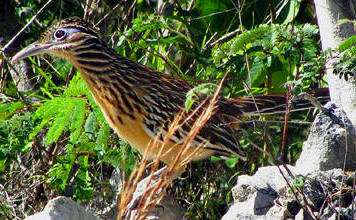 Lesser
roadrunner,
Geococcyx
velox
– is a commonly
solitary bird but it may live in pairs. A
member of the Cuckoo family Cuculidae, order of Cuculiformes.
The Lesser roadrunner
has a dove-like "coo" vocalization. It resembles in
appearance and in its ground foraging habits to the Greater
Roadrunner, Geococcyx californiana; but it is smaller, has a shorter
bill, long tail, slender long legs, black-golden brown and white
streaked plumage. Its head features a patched of bluish bare skin
behind its bulky eyes. Although capable of flying, this is a
terrestrial bird that eats seeds, fruit, insects, small
reptiles such as snakes, lizards and frogs. Forages around
roadsides in arid lowland and scrub for its food and occasional
road-kill. Lesser roadrunners can run up to 20 miles an hour.
Breeding nests care placed in a low bush or cactus. They have
bi-parental care to their young.
There is a disjoint range, restricted island population, of Lesser
roadrunners found in the North of Yucatan Peninsula. Lesser
roadrunner,
Geococcyx
velox
– is a commonly
solitary bird but it may live in pairs. A
member of the Cuckoo family Cuculidae, order of Cuculiformes.
The Lesser roadrunner
has a dove-like "coo" vocalization. It resembles in
appearance and in its ground foraging habits to the Greater
Roadrunner, Geococcyx californiana; but it is smaller, has a shorter
bill, long tail, slender long legs, black-golden brown and white
streaked plumage. Its head features a patched of bluish bare skin
behind its bulky eyes. Although capable of flying, this is a
terrestrial bird that eats seeds, fruit, insects, small
reptiles such as snakes, lizards and frogs. Forages around
roadsides in arid lowland and scrub for its food and occasional
road-kill. Lesser roadrunners can run up to 20 miles an hour.
Breeding nests care placed in a low bush or cactus. They have
bi-parental care to their young.
There is a disjoint range, restricted island population, of Lesser
roadrunners found in the North of Yucatan Peninsula.
Bunting Birds:
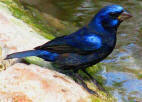 Blue
Bunting,
Cyanocompsa perellina,
belongs
to the passerine bird species.
Small stocky bunting with a stout black bill.
Males have deep dark blue plumage with bright highlights; females have warm
brown plumage and slightly paler belly. They forages on ground, in thickets,
and in bushy areas. If - Order: Passeriformes / Family: Cardinalidae Blue
Bunting,
Cyanocompsa perellina,
belongs
to the passerine bird species.
Small stocky bunting with a stout black bill.
Males have deep dark blue plumage with bright highlights; females have warm
brown plumage and slightly paler belly. They forages on ground, in thickets,
and in bushy areas. If - Order: Passeriformes / Family: Cardinalidae
Indigo Bunting,
Passerina cyanea, (click name to see
photo and information details).
Painted Bunting, Passerina ciris,
(click
name to see photo and information details).
.
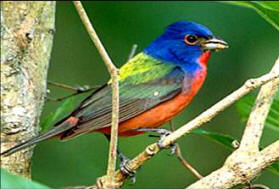
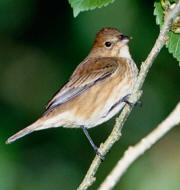
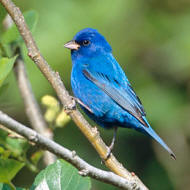
PAINTED BUNTING - Male INDIGO BUNTING - Female INDIGO BUNTING - Male
BACK
TO BIRD GUIDE LIST
Cardinals and Other Grosbeaks:
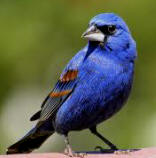 Blue Grosbeak,
Passerina caerula
formally
Guiraca caerulea.
Blue grosbeak birds are in the Northern Cardinal
grosbeak "tropical" family. A passerina migratory bird that forages on the
ground and shrubs eating insects, grains and fruits. Found in partly open
habitat and overgrown fields, this beautiful bird nests in low bushes and
can be found feeding on seeds and wild grassy edges. Blue Grosbeak,
Passerina caerula
formally
Guiraca caerulea.
Blue grosbeak birds are in the Northern Cardinal
grosbeak "tropical" family. A passerina migratory bird that forages on the
ground and shrubs eating insects, grains and fruits. Found in partly open
habitat and overgrown fields, this beautiful bird nests in low bushes and
can be found feeding on seeds and wild grassy edges.
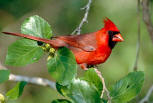 Northern
Cardinal,
Cardinalis
cardinalis,
called "Chak Is'iits'ib" in Maya. These breathtaking deep bright red songbirds
are loved for their beautiful singing notes and familiar shade of red (males) with
black face marks. Females have brown plumage with same sharp crest and show
warm red accents. Northern
Cardinal,
Cardinalis
cardinalis,
called "Chak Is'iits'ib" in Maya. These breathtaking deep bright red songbirds
are loved for their beautiful singing notes and familiar shade of red (males) with
black face marks. Females have brown plumage with same sharp crest and show
warm red accents.
Other Grosbeaks Birds:
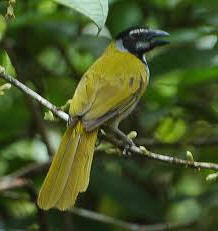
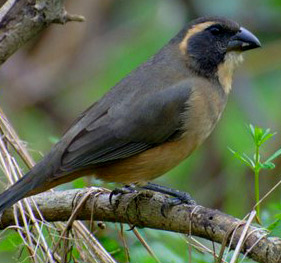
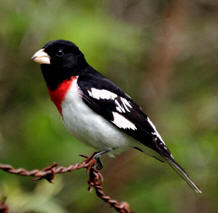
Black-headed Saltator - male
Grayish Saltator - male
Rose-breasted Grosbeak - male
Saltator
coerulescens
Saltator coerulescens
Pheucticus
ludovicianus
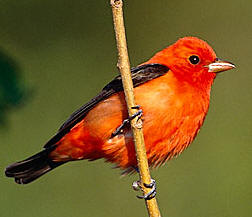 Scarlet tanager, Piranga Olivacea, "Chac yuyum"
in Maya, formally classified in the tanager family Thraupidae now within the genus of the
Cardinal family Cardinalidae. Scarlet tanager's plumage and
vocalization are similar to the cardinal songbirds. Adults males
plumage is bright scarlet red with black wings and tail, while scarlet
females have yellowish underparts, olive tops, brown wings and tail.
Juvenile scarlet birds show complex variegated plumage. They breed in
May and stay till October foraging high in tree tops. Eat
insects in flight but enjoy small berry fruits, building their nests in
horizontal high branches. Scarlet tanager, Piranga Olivacea, "Chac yuyum"
in Maya, formally classified in the tanager family Thraupidae now within the genus of the
Cardinal family Cardinalidae. Scarlet tanager's plumage and
vocalization are similar to the cardinal songbirds. Adults males
plumage is bright scarlet red with black wings and tail, while scarlet
females have yellowish underparts, olive tops, brown wings and tail.
Juvenile scarlet birds show complex variegated plumage. They breed in
May and stay till October foraging high in tree tops. Eat
insects in flight but enjoy small berry fruits, building their nests in
horizontal high branches.
BACK
TO BIRD GUIDE LIST
Currasows and Guans:
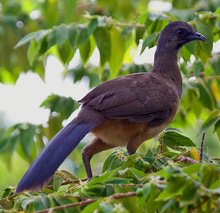
Plain chachalaca,
Ortalis vetula, called Baach in Maya, is a massive large bird in the Cracidae family.
Plain chachalaca birds have long necks, bare throat, small heads and really
long tails. This bird species enjoys feeding on the ground fruits, seeds,
leaves, and flowers. Gliding and leaping through brushy vegetation, plain
chachalaca birds often call with a loud rhythmical chorus early mornings and
evening, many times producing peeping whistles and cackles that mimic
blabbing chatting loud sounds. They breed in early June and their nests look
like a shallow saucer made of twigs, plant fibers and leaves. Plain
chachalaca birds are shy and difficult to view in the open but easy to hear
from a far during the early morning even in the hotel gardens.
BACK
TO BIRD GUIDE LIST
Doves and Pigeons:
There is no difference between a pigeon
and a dove besides the fact that pigeon is a word that comes from the French
"pijon" and "dove" s the in English name for birds of the Columbidae family which includes over 300 species of near-passerine birds
worldwide. However, nowadays we commonly refer to "doves" to the small
members of the species and to "pigeons" to the larger ones; this practical
tendency is also found in ornithology. Pigeons and
doves pair for life and their singing has a
very low resonant note pattern with little variations; they typically
counter sing with group members
creating enthusiastic patterns. The
following doves and pigeons are found at
Hacienda Chichen Bird Refuge in
Chichen Itza,
Yucatan, Mexico. You can observe most of these doves and pigeons, called "Mucuy"
in Maya, at the hotel's main garden
and in our many ficus trees and paths all year:
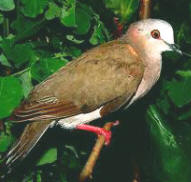 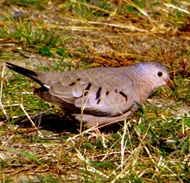 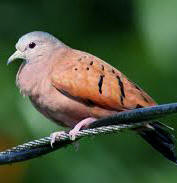 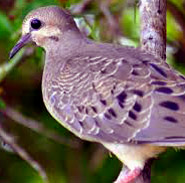
Caribbean dove
Common ground dove Ruddy ground-dove
Mouring
dove
Leptotila jamaicensis Columbina passerine Columbina talpacoti
Zwnaida macroura
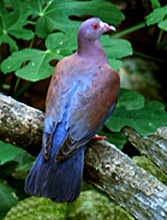
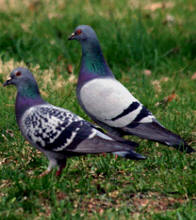
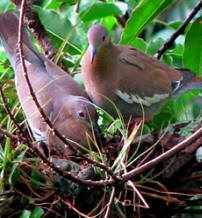
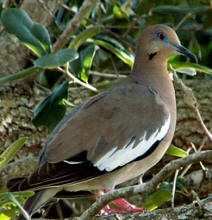
Red-billed pigeon
Rock pigeon - couple
White tipped dove
White winged dove
Patagioenas flavirostris
Columba livia Leptotila verreauxi Zenaida asiatica
BACK
TO BIRD GUIDE LIST
Egret:
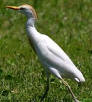
Cattle Egret, Bubulcus ibis, a small gregarious
snowy=white egret distinguished during breeding season by its orange crown
plumes. This ibis has long neck and long yellow pinkish bill that turns
reddish during breeding season; when they monogamous pair within breeding
colonies. The Cattle Egret normally legs also change color during
breeding season from gray-green tones to bright red to orange-brown colors.
This bird species is commonly seen foraging and grazing stock in wetlands
and interior grassy pastures. Cattle egrets love to eat grasshoppers
and insects as well as worms, ticks, small frogs and lizards.
Euphonia and Finch Birds:
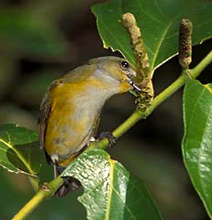
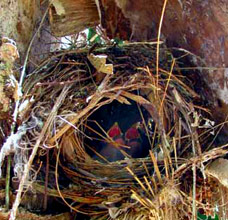
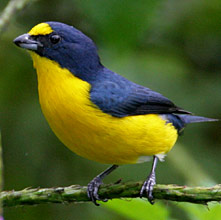
Yellow-throated Euphonia female
(left) breeding nest (center photo) male (right)
Euphonia hirundinacea
Yellow-throated Euphonia
Euphonia hirundinacea
belong to the Tanager
Subfamily, the Thraupinae. This stocky small birds are found all year round
at Hacienda Chichen Resort's gardens in Chichen Itza, Yucatan, Mexico.
Its natural habitats are subtropical dry or moist lowland and disturbed
forests. Note the yellow throat plumage is what distinguish this Euphonia
male from the Scrub Euphonia male that has a black throat plumage. Both parents
care and feed their young.
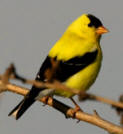 Lesser Goldfinch
or Dark-backed Goldfinch,
Carduelis
psaltria,
is a social small seed
eating finch, often gregarious and enjoys living in small flocks. It is
among the most joyful songbird found year round in Hacienda Chichen Bird
Refuge. It has a small pointed and conical dark bill, dark wings with
large white wing-bars and short notched tail. Lesser Goldfinch
males have bright yellow body plumage with black backs, cap and
wings, though some have dirty green back plumage. Very adaptable to open
habitat settings and forest clearings, it primarily feeds in small groups
moving through low weeds and seeds. Pairs are monogamous, females wove and
line their cup-like nests and the male feeds the female when she is
incubating eggs. Due to their lovely singing they get caught for the
cage bird trade by Maya locals but they are protected at
Hacienda Chichen Bird Refuge and Maya Jungle Reserve. Lesser Goldfinch
or Dark-backed Goldfinch,
Carduelis
psaltria,
is a social small seed
eating finch, often gregarious and enjoys living in small flocks. It is
among the most joyful songbird found year round in Hacienda Chichen Bird
Refuge. It has a small pointed and conical dark bill, dark wings with
large white wing-bars and short notched tail. Lesser Goldfinch
males have bright yellow body plumage with black backs, cap and
wings, though some have dirty green back plumage. Very adaptable to open
habitat settings and forest clearings, it primarily feeds in small groups
moving through low weeds and seeds. Pairs are monogamous, females wove and
line their cup-like nests and the male feeds the female when she is
incubating eggs. Due to their lovely singing they get caught for the
cage bird trade by Maya locals but they are protected at
Hacienda Chichen Bird Refuge and Maya Jungle Reserve. 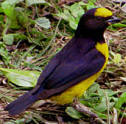
Scrub Euphonia,
Euphonia affinis,
order Passeriformes, Family Carduelidae. Scrub Euphonias are truly
social gregarious tiny birds. Males have a blue black head,
upperparts, wings and neckline with bright yellow fore-crown and under-parts.
Females have a duller pale yellow belly and greenish gray upper plumage.
It has a variety of habitats but is commonly found in our scrubby woodland
and royal palms when they produce their small fruits. Scrub Euphonias
make different calls with double and tripled dee or deen notes. They
often mixed with other bird species near trees that are baring fruits.
BACK
TO BIRD GUIDE LIST
Falcons and Caracaras:
Caracas are raptors (birds
of prey) in the Family Falconidae, members of the true falcon subfamily
subfamily Falconinae found principally in South America, Central America and
the south region of USA. Caracaras are often scavengers and falcons
are aerial hunters, both are carnivorous. These are the caracaras and
falcons found at
Hacienda Chichen Maya Jungle and Wildlife Reserve:
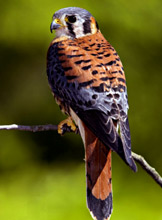
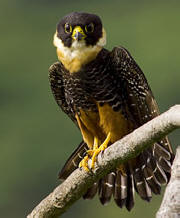
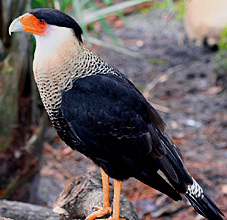
American Kestrel
Bat Falcon
Crested Caracara
American Kestrel,
Falco sparverius, called I'kos in Maya,
are the smallest falcons observed at
Hacienda Chichen Wildlife
Reserve as winter visitors. Males have truly attractive facial
feather patterns with a blue-gray crown and white with black throat bands;
their back wings have golden brown plumage with black spots and their wings
long blue-gray feathers, their tail under-parts have black and golden brown
bands ending with a white tip (see above left photo). Females are similar in
size but their plumage is less colorful with mostly golden brown and dark
brown body spots and bands. Adapted to various habitats, American Kestrel
hunts by perching or hovering for small pray typically lizards, mice and
small animals. Nests in tree cavities and both parents help incubating and
feeding their offspring.
Bat Falcon,
Falco rufigularis a small bird of prey and resident breeder that can be
observed in forest clearings or perching conspicuously on high open dead
tree branches from where they launch their aerial attacks to their pray such
as bats, birds, and large insects. Females are larger than
males. Adults have a black head, back, and tail; the throat and upper chest
are creamy white with fine barred white bellies. Has a distinctive
high pitched call.
Crested Caracara,
Caracara cheriway, also called Northern Crested Caracara. A slow
flying falcon found in most of Mexico, Cuba and Central America, truly
voracious omnivorous scavenger found in semi-open country habitats. It
enjoys carrion but eats on ground small mammals,
insects and
reptiles. Males have broad wings, long tail and
legs; frequently found walking and running on ground. Sexes are
similar in size and plumage, with black long feathers a top of the head,
bright orange cere or facial skin, and hooked white bills.
Laughing Falcon
Peregrine Falcon
Crested Caracara
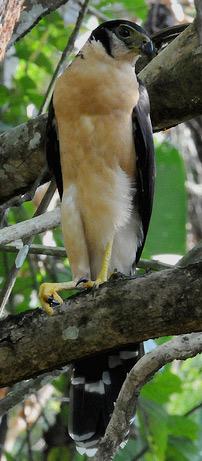
Collared Forest Falcon,
Micrastur
semitorquatus,
(extreme left photo)
is the largest member of its genus.
You will find it in the wild within Hacienda
Chichen Maya Jungle Reserve grounds; this falcon has face mask, yellowish legs and dark tail with light bars.
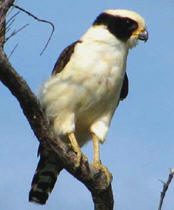
Laughing Falcon,
Herpetotheres cachinnans
(Kos in
Maya)a Neotropical falcon species of the subfamily Polyborinae that enjoys
mostly eating snakes. His call is an unmistakable laughing aloud
sound. As with most birds of pray, this falcon's female is bigger than
males. Adults have pale buff head with a broad black face mask across
neck; it has white body plumage and a banded tail with black brownish wings.
Prefers humid semi-open habitats.
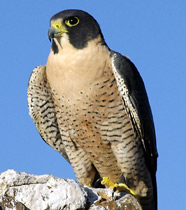
Peregrine Falcon,
Falco peregrinus, a great hunter from the family Falcomidae that preys
on birds and bats in mid-flight (speeds over 200 mhp). This large crow sized
falcon mates for life and prefers wide open spaces. It has beautiful barred white under-parts and a
black head band over his eyes and a banded tail. Winter visitor to
Hacienda Chichen Bird Refuge.
BACK
TO BIRD GUIDE LIST
Flycatcher and Antbirds:
Flycatcher family of birds from the order
of Passeriformes. Many flycatchers are great songbirds and truly have a
beautiful plumage. This large group of birds includes various species, all
of which feed mainly on insects that are caught during fly, many feed also
on small fruits or berries. Flycatchers have incredible aerial skills and
spend time perching on various territories and habitats. These are the
flycatchers found at Hacienda Chichen Bird Refuge and Maya Jungle Wildlife
Reserve, in Chichen Itza, Yucatan, Mexico:
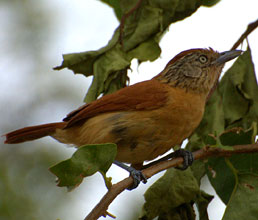
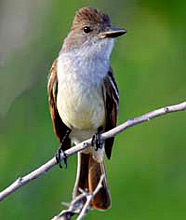
Barred antshrike - male
Barred antshrike -
female
Brown-crested flycatcher
Thamnophilus doliatus
Thamnophilus doliatus Myiarchus
crinitus
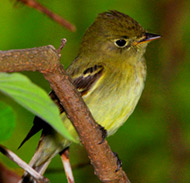
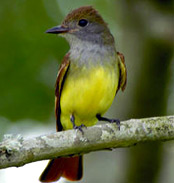
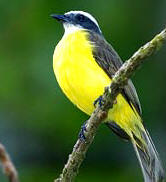
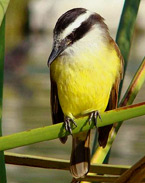
Yellow-bellied Flycatcher Great crested flycatcher Social
Flycatcher
Great Kiskadee
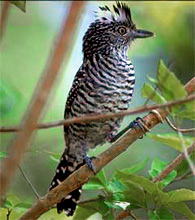
* Barred antshrike,
Thamnophilus doliatus, is a
non-migratory territorial antbird found at Hacienda Chichen Bird Refuge,
enjoys dense scrub areas in secluded paths. Sexually dimorphic songbird,
male has a striking plumage alternating black and white bars all around its
body and features a distinctive black feathered head crown; females have a
cinnamon-rufous upper plumage with an ocher body tone and stripped head
plumage. Both have strong large bills and live as pairs, producing duet long
songs during breeding; incubate two purple marked eggs. Feed on insects and
follow ant swarms.
(photo above*)
Boat-billed flycatcher, Megarynchus pitangus - it is named X'takay
in Maya as
all birds with similar head and body plumage colors. Boat-billed
flycatcher, are the largest species of the tyrant flycatcher and the only
member (monotypic) of the genus Megarynchus. Breeds near the front of
Hacienda Chichen open gardens
with tall trees; its nest is built with sticks in a saucer shape by the
female for the incubation of two or three eggs. Its large bill helps
bird-lovers distinguish it from the Great Kiskadee which has similar
plumage. Feeds on insects, small invertebrates and ficus berries.
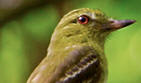 * Bright-rumped attila, Attila spadiceus, has a variable olive
brown plumage but its streaking yellowed belly end and obvious dark brown
wings with two pale wing-bars help birders identify it. A small tyrant
flycatcher It perches while singing and prefers shady garden areas; eats
insects as well as seeds and berries. Nests in the quiet areas of Hacienda
Chichen property, building deep cups of mosses, leaves and soft
pochote fiber, incubates two pale lilac marked light pink eggs.
*left photo * Bright-rumped attila, Attila spadiceus, has a variable olive
brown plumage but its streaking yellowed belly end and obvious dark brown
wings with two pale wing-bars help birders identify it. A small tyrant
flycatcher It perches while singing and prefers shady garden areas; eats
insects as well as seeds and berries. Nests in the quiet areas of Hacienda
Chichen property, building deep cups of mosses, leaves and soft
pochote fiber, incubates two pale lilac marked light pink eggs.
*left photo
* Brown-crested flycatcher, Myiarchus
crinitus, a passerine songbird in the
tyrant flycatcher family, both sexes have similar plumage of gray breast,
lime yellowish belly, whitish neck, olive-brown upperparts and a dark short
flat crest head. What helps ID this species from other birds of the genus is
its sharp repeated notes and rough call. Feeds on insects and berries, built
nests for two purple marked cream eggs in tree cavities or man-made holes.
(photo in
above collection*)
 * Couch’s kingbird,
tyranuus couchii,
a passerine tyrant flycatcher resident of
Hacienda Chichen Bird Refuge belonging to the kingbird genus. Has a
large head and bill for its seven inches body; pale gray head with darker
cheeks, olive-gray upperparts with a pale throat and bright yellow breast.
Best observed in overgrown shrubs areas perching in elevated tree branches
around the gardens. It has a distinctive nasal buzz song note. Nests in
isolated trees build untidy bowls of twigs and bark strips lined with
pochote
and fine rootlets.
(*left photo) * Couch’s kingbird,
tyranuus couchii,
a passerine tyrant flycatcher resident of
Hacienda Chichen Bird Refuge belonging to the kingbird genus. Has a
large head and bill for its seven inches body; pale gray head with darker
cheeks, olive-gray upperparts with a pale throat and bright yellow breast.
Best observed in overgrown shrubs areas perching in elevated tree branches
around the gardens. It has a distinctive nasal buzz song note. Nests in
isolated trees build untidy bowls of twigs and bark strips lined with
pochote
and fine rootlets.
(*left photo)
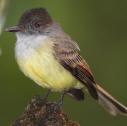 * Dusky-capped flycatcher, Myiarchus tuberculifer,
another passerine tyrant flycatcher that breeds
during winter at the Hacienda Chichen Bird Refuge and gardens. Both sexes
have same plumage: gray breast, yellowish belly, blackish short crest head
and brown upperparts with pale outer tail and wings feathers. It is a bit
difficult for a birder to ID as it is also Similar to other Myiarchus
species such as the Myiarchus
crinitus, but the dusky-capped is a bit
smaller in size and has a sorrowful whistled note. Loves gumbo-limbo
berries but feeds mostly on insects that catches in fly. Builds its nest on
tree cavities incubating normally three small brown marked buff eggs.
(right photo) * Dusky-capped flycatcher, Myiarchus tuberculifer,
another passerine tyrant flycatcher that breeds
during winter at the Hacienda Chichen Bird Refuge and gardens. Both sexes
have same plumage: gray breast, yellowish belly, blackish short crest head
and brown upperparts with pale outer tail and wings feathers. It is a bit
difficult for a birder to ID as it is also Similar to other Myiarchus
species such as the Myiarchus
crinitus, but the dusky-capped is a bit
smaller in size and has a sorrowful whistled note. Loves gumbo-limbo
berries but feeds mostly on insects that catches in fly. Builds its nest on
tree cavities incubating normally three small brown marked buff eggs.
(right photo)
* Eastern Wood-Pewee, Contopus virens, another common
migrating flycatcher found at Hacienda Chichen grounds, adults have gray
olive upperparts with two wing bars and light underparts, also a light olive
wash on their breasts. This small songbird has a whistled singing note that
gave rise to its name. Easter Wood-Pewee has a clear loud chip call
with alternative notes when singing; they build open cup nests made of grass
and bark both sexes are territorial and defend their nest aggressively, they feed mainly
on insects.
(photo click here)
* Great crested flycatcher, Myiarchus crinitus, loves to hunt
insects from deciduous forest treetops; thus, easier to be hear than seen.
The great crested flycatcher is a mid-size songbird with bright yellow belly
and cinnamon Rufus wings and tail that has pale wing-bars. Breeds in
open deciduous semi-open areas and nests in cavities lining them with
snakeskin and soft bark and small twigs.
(photo
found in our above flycatchers collection*)
* Great Kiskadee, Pitangus sulphuratus,
called X'takay in Maya as do all similar color plumage birds do. This
is a large tyrant songbird, measures aprox. 11 inches) that enjoys perching
on tall trees in open areas. It is considered monotypic. It has a black
short and thick bill bright yellow under-part, black head with a strong
white eye-stripped. It has a strong noisy call. Almost omnivorous, a great
hunter. Both sexes build the ball like nest with a side entrance. Three
cream eggs with reddish brown blotches are incubated. Territorial and
a bit aggressive with other species.
 (photo in
our flycatcher set above*) (photo in
our flycatcher set above*)
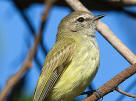
Greenish Elaenia, Myiopagis viridicata, a perching
resident flycatcher from the Tyrannidae family. A small bird with grey head and short
beak with some yellow on wing bend and no wing bars; its grey throat merges
into a olive dusky chest and pale breast and belly. Best ID for its
buuur-zeeep call note, it
is truly a shy bird and usually is found in the garden bushes where some clearing
areas are quiet at Hacienda Chichen gardens, perching
solitary up high.
Least flycatcher,
Empidonax minimus, migratory songbird
visitor in Spring that has white underbelly and olive-gray coloring on the back. Two
white bars on their wings help identify it from other flycatchers. Feeds
hawking from the air on insects.
 Northern Bentbill,
Oncostoma cinereigulare, native to Mesoamerica, this small resident
flycatcher can be observed in numerous areas of Hacienda Chichen. A member of
the Tyrannidae family, it perches in small bushy shrubs around the gardens.
Has an olive-grayish upper-part and pale lime yellow chest and belly with
thin orange with small dark mark curved beak. Feeds mostly on small
berries, spiders and flies. Solitary by nature even during
breeding season Mar,ch / April. Nests are globular structure
pendants built with vegetable fibers between 30 to 60 cm above ground;
female lays one or two eggs. Northern Bentbill,
Oncostoma cinereigulare, native to Mesoamerica, this small resident
flycatcher can be observed in numerous areas of Hacienda Chichen. A member of
the Tyrannidae family, it perches in small bushy shrubs around the gardens.
Has an olive-grayish upper-part and pale lime yellow chest and belly with
thin orange with small dark mark curved beak. Feeds mostly on small
berries, spiders and flies. Solitary by nature even during
breeding season Mar,ch / April. Nests are globular structure
pendants built with vegetable fibers between 30 to 60 cm above ground;
female lays one or two eggs.
*
Social
flycatcher, Myiazetetes similis -
(X'takay in Maya)
is a member of the tyrant
flycatcher bird family. Social flycatchers plumage resemble that of Boat-billed flycatchers and Great
Kiskadee birds; however social flycatcher adult birds are smaller,18 cm. long. The male head has a dark almost black crown with
a strong white eye stripe; the upperparts are olive brown, wings
and tail have gray brown feather tones. Social flycatcher belly
and under-parts are bright yellow and the throat is white. At the
Hacienda Chichen these cheerful birds' calls chips-k'-cheery are
sang all day long to the enjoyment of guests and visiting birders.
Social flycatcher birds love to perch in the open terraces of the hotel
and feed on small berries from many of the trees around the hotel's main
arch. They nest near water from February to June.
(photo found in our above flycatchers collection*)
 Sulphur-bellied flycatcher,
Mylodynastes luteiventris - A resident of Hacienda Chichen's main
garden, this lovely tyrant flycatcher belongs to the Passeriformes order.
It has distinctive strong
streaking in its plumage, a black eyes-tripe, pale yellow-lime colored belly, and
a deep rusty brown tail. Its call has a deep squeaky sound as it perches on high tree
branches in semi-open garden areas. These flycatchers' nest are shaped
like a cup, and can be found in old
woodpecker holes or tree cavities with two to four small eggs. Suphur-bellied
flycatchers hawk their prey, normally feeding on insects, but also enjoys seeds and berries. Sulphur-bellied flycatcher,
Mylodynastes luteiventris - A resident of Hacienda Chichen's main
garden, this lovely tyrant flycatcher belongs to the Passeriformes order.
It has distinctive strong
streaking in its plumage, a black eyes-tripe, pale yellow-lime colored belly, and
a deep rusty brown tail. Its call has a deep squeaky sound as it perches on high tree
branches in semi-open garden areas. These flycatchers' nest are shaped
like a cup, and can be found in old
woodpecker holes or tree cavities with two to four small eggs. Suphur-bellied
flycatchers hawk their prey, normally feeding on insects, but also enjoys seeds and berries.
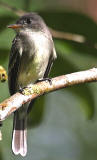
* Tropical Pewee,
Contopus cinereus, another small tyrant flycatcher found at the edges of
the gardens perching in Hacienda Chichen tall ficus. Large in numbers, they
reside in the grounds all year round, nesting in small open saucers made our
of soft grass and linchen chunks, built in branch forks by the female who
lays two creamy off white eggs marked with red-brown spots, both parents
defend their nest aggressively specially from the Great kiskadeee.
Dark brownish grey under-parts and dark grey crown plumage, a pale olive
yellow belly as well as two white wing bars with some variations on plumage
are common in this species.
Its call has a sharp weeet call.
(right photo* )
Tropical Kingbird,
Tyrannus
melancholius (X'takay in Maya), this large tyrant Flycatcher is one
of the many resident songbirds at Hacienda Chichen gardens and grounds.
Both sexes are similar with pale-gray head plumage and a darker eye
mask, they showcase an orange crown stripe and a heavy grey bill. The
back is greyish-green, and the wing and forked tail are brown. The
throat is pale grey, becoming olive on the breast, with the rest of the
underparts being yellow. Their call has a high-pitched twittering trill
note. They defend their territory with an aggressive behavior toward
other birds, They nest in ficus in upper tree cannopies.
Yellow-bellied elaenia, Elaenia flavogaster, another songbird
from the tyrant flycatcher family common to the Yucatan peninsula. It is
a conspicuous little bird that has yellow-olive under-parts, white eye-ring and bushy crest. it has a
nasal call and can be found around the gardens eating insects and small
berries. Builds cup nests.
Yellow-bellied flycatcher, Empidonax flaviventris, a noisy
little
flycatcher with a large
semi-crested head, yellowish eye-ring,
yellowish cream throat and breast, two broad yellow or white wing-bars. Yellow-bellied
flycatchers are found in semi-open habitats.
Yellow-olive flycatcher, Tolmonyias sulphurescens, a small
songbird found at Hacienda Chichen Resort's grounds. Feeds on insects,
small seeds and berries. Its call is a nasal breeer, and the song
has a wheezing zhu-zhee-zhu-zhee note. It makes a cup nest and lays two
cream eggs with reddish blotches at the larger end.
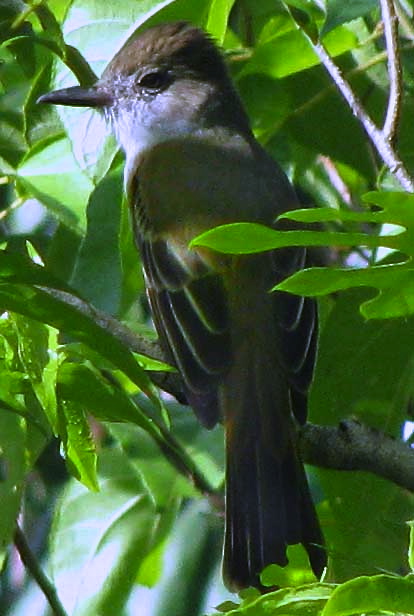 * Yucatan flycatcher,
Myiarchus yucatanensis – a small tyrant
flycatcher and an endemic bird species of the Yucatan Peninsula, called X'takay
in Maya, as ancient Maya grouped birds for their plumage alike color design
and habits. This small flycatcher bird resides all year round at
Hacienda Chichen Resorts garden edges near the rejoyadas on mid-range
cannopy. There are three subspecies currently recognized: Myiarchus
yucatanensis,
Myiarchus lanyoni, and Myiarchus navai, all
within the Maya world (Yucatan Peninsula, Chiapas, Guatemala and Belize) it
is easy to ID mainly due to its vocal characters.
(right photo*) * Yucatan flycatcher,
Myiarchus yucatanensis – a small tyrant
flycatcher and an endemic bird species of the Yucatan Peninsula, called X'takay
in Maya, as ancient Maya grouped birds for their plumage alike color design
and habits. This small flycatcher bird resides all year round at
Hacienda Chichen Resorts garden edges near the rejoyadas on mid-range
cannopy. There are three subspecies currently recognized: Myiarchus
yucatanensis,
Myiarchus lanyoni, and Myiarchus navai, all
within the Maya world (Yucatan Peninsula, Chiapas, Guatemala and Belize) it
is easy to ID mainly due to its vocal characters.
(right photo*)
BACK
TO BIRD GUIDE LIST
Galliforms:
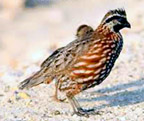 Yucatan
bobwhite or Black-throated bobwhite, Colinus nigrogularis, "Bech" in Maya. Like its
northern relative, though smaller, this endemic quail emits a sound like
a masked bobwhite. It belongs to the Odontophoridae family. The male's
face is black with white stripes above and below their eyes. This
bird has a black throat and a reddish brown crown; the chest and belly
plumage is white with black in a very noticeable
pattern of flakes. The back, wings and tail are
reddish brown. Females are similar to the northern masked bobwhite quail
with chestnut throat. Yucatan
bobwhite or Black-throated bobwhite, Colinus nigrogularis, "Bech" in Maya. Like its
northern relative, though smaller, this endemic quail emits a sound like
a masked bobwhite. It belongs to the Odontophoridae family. The male's
face is black with white stripes above and below their eyes. This
bird has a black throat and a reddish brown crown; the chest and belly
plumage is white with black in a very noticeable
pattern of flakes. The back, wings and tail are
reddish brown. Females are similar to the northern masked bobwhite quail
with chestnut throat.
BACK
TO BIRD GUIDE LIST
Grackles
and Cowbirds:
Almost all black feathered birds are called
Pi’ich (such as the black
melodious bird) or X'Kau (grackles and cacique) in Maya, even though
they are not of the same bird family or bird species: see photos bellow,
Black Melodious is a songbird that delights anyone with its lovely melodious
singing notes at Hacienda Chichen Bird Refuge and Gardens.
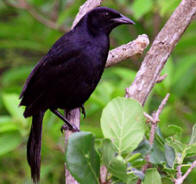
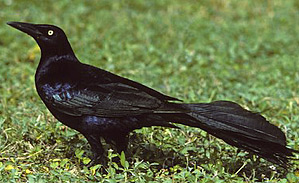
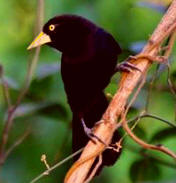
Melodious
Blackbird
Great-tailed Grackle Yellow-billed cacique
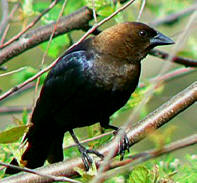
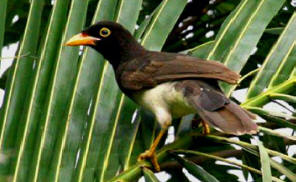
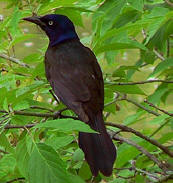
Bronzed cowbird
Brown Jay
Common grackle
*
Melodious blackbird,
Dives dives,
endemic to the New World Icterid bird list, and
there is no subspecies. This midsized black songbird resides in tropical
regions, from the East Mexican coastline, to the Yucatan peninsula and
down to Costa Rica. This delightful melodious songbird is a permanent
resident at Hacienda Chichen, you can hear its joyful songs around the
hotel's gardens all day long. This blackbird enjoys visiting guests at
meal time at the terrace restaurant for a few treats, fruit, seeds, and
even a bit of warm bread. Males and females have identical black bluish
glossy plumage, their eyes, feet and bill are deep black. These birds
seen in a duet pair with many joyful notes, whistles, and calls. Prefers
open spaces and forages insects,, mainly on the ground; loves to feed on
nectar and sweet fruits. Highly territorial, especially during
breeding season. Both sexes build a cup nest high in tree branches. The
female lays three or four brown-blotched blue eggs, which she incubates
alone, although the male helps with feeding the chicks.
( first top
photo found left side in our above photo set*)
*
Common grackle,
Quiscalus quiscula,
(Pi’ich in Maya)
is a permanent resident and very common in Yucatan. A large black bird
from the Icteridae family, the male is just a bit larger than the
female. As adults both have long dark tail, long dark bill and pale
yellowish eyes Their feathers appear black with iridescent purple, green
or blue shades on their head. Nest are concealed in lush tall tree
branches.
( last
bottom right photo found in our above set*)
* Yellow-billed cacique,
Amblycercus holosericeus (called also Pi’ich in Maya)
Another
resident bird to the Hacienda Chichen gardens. It is a large black bird
with deep yellow peak and bright yellow eyes from the Icteridae family.
Not a true cacique but related to the species, this impressive monotypic
bird belongs to the genus Amblycercus. Has a long black shinny tail; it
feeds by pecking leaves and twits for insects. The nest has a classic
cup-shaped made of twits and fibers. The Yellow-billed cacique found in
Yucatan is a lowland bird with no relationship to the bamboo specialized
group found in Costa Rica.
-
(left top
photo found in above photo set*)
* Great tail grackle,
Quiscalus mexicanus
(X'Kau in
Maya)
is a common resident to our gardens
native to North and Central America. It has a medium size
with deep black and violet-blue iridescent plumage and a long slender
tail. Another member of the Icteridae family, this bird can rich up to
17 inches in length. The great tail grackle has a vast range of call
notes, some quite melodic. You can spot them easily at sundown and
down often congregated in large flocks. Cunning and opportunists
by nature, these birds are brave and approach humans for food and scraps
as they are omnivorous. -
(center top
photo found in our above bird photo collection*)
* Bronzed cowbird or Red-eyed cowbird,
Molothrus aeneus this Icteridae bird is smaller than those
in above, it is also a common resident to the Yucatan; the male has a
green-rusty-brown neck and head coloration with shinny black body
plumage. The female is smaller and has a duller look, she lays its eggs
in other bird species nests such as the prevost's ground sparrow and the
yellow-throated brush finch; her young are fed by such bird parents.
-
(bottom
left photo found in our above bird photo collection*)
* Brown Jay,
Psilorhinus morio, please click here for brief
info-
It
is displayed
in the above, bottom center, photo set since the Maya people commonly
group birds by color not species; thus, it is in the Maya family of the
deep dark birds or Box Kau (black / brown plumage).
BACK
TO BIRD GUIDE LIST
Gnatcatchers and Grassquits:
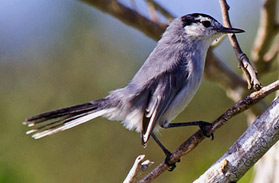
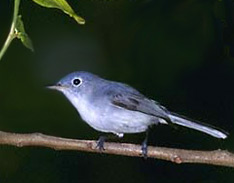
White-lored
gnatcatcher
Blue-gray
gnatcatcher - female
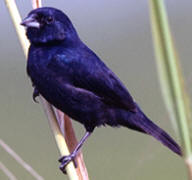
Blue-black grassquit
Blue-gray
gnatcatcher, Polioptila caerulea, looking like a miniature mockingbird, this little bird has a lovely
blue-gray feathers atop and white belly with a distinctive white eye ring,
broad white borders on black tail. Male have a deep blue gray eyebrow band,
females do note (above photos). Parents are quite vocal and build exquisite nests,
lovely singing birds.
White-collared seedeater Yellow-faced grassquit
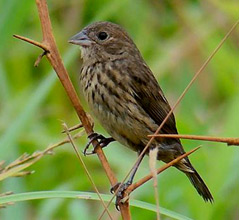
Blue-black grassquit - female
Blue-black grassquit, Volatinia jacarina, resident of
Hacienda Chichen Bird Refuge, this lovely songbird has deep blue black
plumage all over its body. These grassquit birds form flocks and enjoy
feeding in open weed fields and habitats.
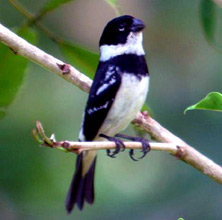
* White-collared seedeater, Sporophila torqueola, a passerine bird
that has a softh delightful call and whistled singing feeds in the low
weedy places of Hacienda Chichen gardens, thus, the hotel leaves tall
weedy areas around the garden near the Church. they nest in small
colonies and sing to defend their territory. Both parents feed seeds and
small insects to their young.
White-lored
gnatcatcher, Polioptila albiloris, males have glossy black caps
extended to their eyes as it curves around the white cheek. It is found
at Hacienda Chichen's semi-arid scrubby garden areas. Its call has a
nasal scratchy sound and pairs breed during spring and early summer.
They eat insects: caterpillars and small beetles.
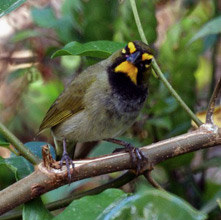
Yellow-faced grassquit, Tiaris olivacea,
is a small passerine seedeater and a melodious bird with a sharp
conical bill; males have a bright yellow throat with deep olive green
backs, gray legs, black plumage on breast and face. Females have dull
olive green plumage and pale grayish underparts. Their call has a low
soft buzzing sound with high rapid trills.
BACK
TO BIRD GUIDE LIST
Hawks and Goatsucker Birds:
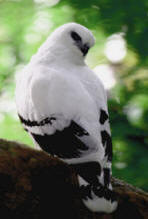
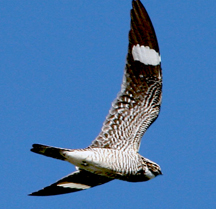
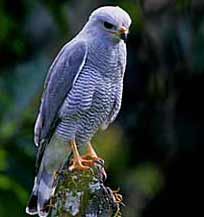
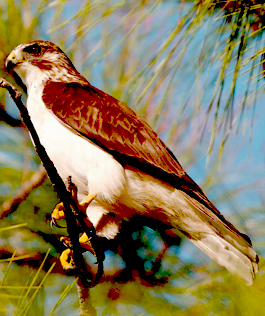
White Hawk
Common Nighthawk at dusk
Gray Hawk male
Short-tailed Hawk
Common Nighthawk,
Chordeiles minor, with an appearance similar to owls, this nocturnal
insectivore hawk, is a migrating hawk difficult to spot during the
daytime. Best seen at dusk and twilight hours. Has a distinctive plumage
dark brown and gray coloration and patterns, slender dark wings with
large white patch. Distinguished by its forked tail, this hawk prefers
to perch when resting or take flight; it is easy to locate at dusk due
to its clear vocalization. It enjoys roosting together, but it is primarily a solitary
territorial hawk. It can measure up to 10 inches and has a five year
lifespan. Feeds on insects mainly. Do not disturb, they are
know to attack intruders.
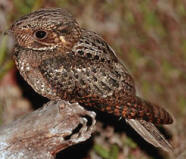
Chuck-will’s-widow,
Caprimulgus carolinensis, the largest nightjar in America, ranging
up to 23 inches in length. A migrating nightjar famous for its
repetitive vibrating night calls, thus its name. With a short bill and
long tail, this bird has reddish brown feathers lined with black and
white patterns (see photo), males have white patches on their outer
tail. Its nocturnal insects, small birds and bats. Females lay spotted
pinkish - lavander eggs on dead leaves on the ground.
Gray Hawk,
Buteo nitidus, a neo-tropical raptor or
bird of
prey that breeds at Hacienda Chichen's lush gardens
and
wild forest edges. This beautiful raptor is know to Mayans
as Yoksadz. Adult Gray hawks reach up to 50cm in
height
and hunt for food primarily using their talons; these raptors
eat lizards, snakes,
birds, small animals. Gray hawks
display
a characteristic curved tip to their beak. They have superb
vision and hunting skills. Grey hawks also they have strong
pale grey bodies, black tail with three wide white bands.
Wings are gray, their striking stripped gray and white feather pattern
covers breast; Gray hawks have strong orange legs.
Gray hawks are short winged and have a fast agile flight. Territorial in
nature; they highly guard their breeding grounds; their nests usual are
high and have two pale blue white eggs.
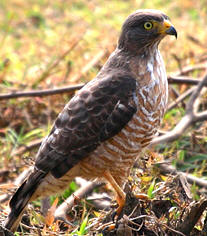
Roadside Hawk Chuck-will’s-widow
Lesser Nighthawk
Yucatan nightjar
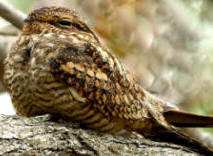
Lesser Nighthawk,
Chordeiles acutipennis,
is very similar to the
common nighthawk but a bit smaller. Both have redish-brown-gray
patterning on the upperparts and chest, but the Lesser nighthawk has a
puffier breast and under plumage with a softer coloration. What helps
distinguish them in the field, is that their calls are completely
different sounds, the Lesser nighthawk call has a rapid melodious rhythm
that lasts for couple of minutes. They also nest on the ground or on
flat roof structures; eggs are off white with multiple tiny brown spots,
look dirty. Aggressive and territorial when nesting and breeding.
they eat at night many insects while in flight. You can spot them
sometimes near our garden tall lights due to the insects attracted to
them.
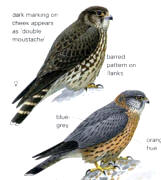 Pigeon Hawk or Merlin, Falco Columbarius,
a migratory bird of prey
that has taken residence at Hacienda Chichen's private Nature Reserve.
Easy to distinguish among other falcons. The drawing placed in this
page, will help you recognize both female and male adults. Argument
still flows if genetically the Eurasian an North America populations are
distinct species. It has a wingspan of about 29 inches and a
robust built; males have blue gray back and buff under-parts with orange
tinted marks. Females have a brownish gray back and spotted
under-part marks. They are easier to find at the Hacienda Chichen's
private Nature Reserved grounds during the winter months. Pigeon
or Merlin Hawks are great hunters, fly fast and low searching for pray
but can catch other birds in mid-air. It is very important to
protect their habitat and breeding area as over disforestation is
widespread. Pigeon Hawk or Merlin, Falco Columbarius,
a migratory bird of prey
that has taken residence at Hacienda Chichen's private Nature Reserve.
Easy to distinguish among other falcons. The drawing placed in this
page, will help you recognize both female and male adults. Argument
still flows if genetically the Eurasian an North America populations are
distinct species. It has a wingspan of about 29 inches and a
robust built; males have blue gray back and buff under-parts with orange
tinted marks. Females have a brownish gray back and spotted
under-part marks. They are easier to find at the Hacienda Chichen's
private Nature Reserved grounds during the winter months. Pigeon
or Merlin Hawks are great hunters, fly fast and low searching for pray
but can catch other birds in mid-air. It is very important to
protect their habitat and breeding area as over disforestation is
widespread.
Roadside Hawk, Buteo Magnirostris, is a laud small
bird of prey with many subspecies; thus, its plumage can vary from brown
to grey hues and tones with stripped like patterns in its underparts. It
has a large deep yellow peak with dark ending mark. In flight you
can observe its short wings compared to its longer tail. This hawk is
well adapted to our ecosystem and has aggressive temper, specially at the
time of breeding and nesting. Feeds on insects and small
mammals.
Short-tailed Hawk,
Buteo albonotatus
White Hawk, Leucoptemis albicollis,
(see photo
under title Hawks)
a laud
Yucatan
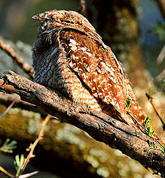
nightjar,
Caprimulgus badius, called "Box Pujuy" in Maya, is very
similar to the Yucatan poorwill and non-professional birders may confuse
both in field. But Yucatan nightjar has more white at the tail tip and
wider white forecollar. Plumage is extremely similar in pattern and
color. Their nocturnal call notes are very rhythmic clear and very
loud. They enjoy same habitat ambience as the Yucatan poorwill.
Lays its eggs on the ground.
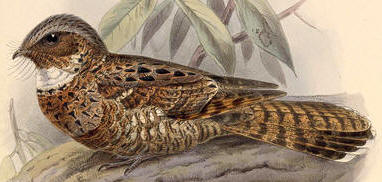 Yucatan poorwill,
Nyctiphrynus yucatanius,
called "Chac Pujuy" in Maya, this endemic mid-size nightjar
belongs to the Caprimulgidae family. It is protected at Hacienda Chichen's
private Nature Reserve.
Nocturnal and very territorial; enjoys quiet semi-arid deciduous forest
areas, feed on insects from ground and perches on tree. Male emits
repetitive loud rhythmic calls at dusk.
Males and females have similar plumage that blends perfectly with bark and
dry leafs making it difficult to spot. Upperparts brown streaked
brown-blackish, distinct spot on wing-coverts, a narrow white collar, and
truly small peak. Lay eggs on the ground, both parents caretakers. Yucatan poorwill,
Nyctiphrynus yucatanius,
called "Chac Pujuy" in Maya, this endemic mid-size nightjar
belongs to the Caprimulgidae family. It is protected at Hacienda Chichen's
private Nature Reserve.
Nocturnal and very territorial; enjoys quiet semi-arid deciduous forest
areas, feed on insects from ground and perches on tree. Male emits
repetitive loud rhythmic calls at dusk.
Males and females have similar plumage that blends perfectly with bark and
dry leafs making it difficult to spot. Upperparts brown streaked
brown-blackish, distinct spot on wing-coverts, a narrow white collar, and
truly small peak. Lay eggs on the ground, both parents caretakers.
Zone-tailed Hawk, Buteo albonotatus
BACK
TO BIRD GUIDE LIST
Hummingbirds:
All hummingbirds are called
Dzunum
or Tz'unu'un in Yucatec Maya language.
Hummingbirds are a joy to observe and very difficult to photograph due
to their speed and tinny bodies. Bellow are the various colorful
hummingbirds you will find at
Hacienda Chichen Resort gardens and private Maya Nature Reserve.
Easy to spot drinking our flower's nectar early morning, specially from
the Heliconia family near the terrace restaurant and
Yaxkin Spa.
Hummingbirds belong to the order Apodiformes; there are three families:
Trochilidae (hummingbirds), Hemiprocnidae (tree swifts), and Apodidae
(swifts). Trochiline male hummingbirds often have bright, colorful
iridescent feathers while their female counterparts have lighter
coloration. Both sexes have elongated narrow beaks, extendable
tongues and a vivid hovering flight. Trochilines are territorial
solitary birds, they feed mainly on nectar and a few insects.
Hummingbirds are polygynous, only females build nests and care for their
young. Learn more about
hummingbirds, by ADW, University of
Michigan.
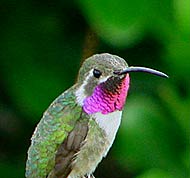
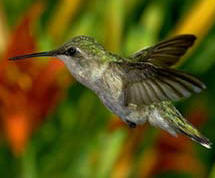
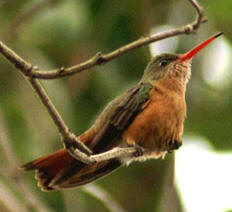
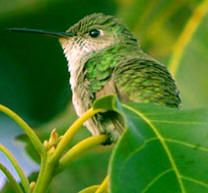
Mexican sheartail
Emerald-chinned
hummingbird
Cinnamon hummingbird
White-bellied Emerald
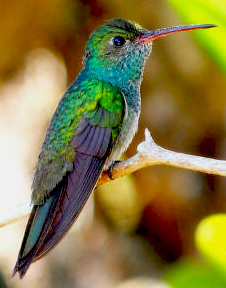
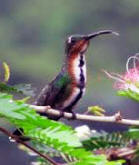

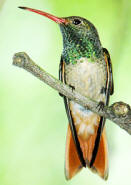
Canivet’s Emerald / Wedge-tailed sabrewing / Green breasted mango female
and male / Buff-bellied
* Buff-bellied Hummingbird, Amazilla yucatanensis -
called Dzunum
or Tz'unu'un
in Maya -
(right bottom photo)
* Canivet’s Emerald hummingbird,
Chlorostibon canivetii, weights less than an once and grows up to 3
inches. At
Hacienda Chichen Bird Refuge, you can observe the subspecies C.c.
salvini which is protected as it is listed as an endangered bird. The
male has metallic emerald feathers with a forked dark blue tail, almost
black. Females have less bright green plumage with a dark eye mask and a
white top line. Easy to spot in our gardens near the lovely heliconias,
specially early morning hours. -
(left
bottom photo)
* Cinnamon hummingbird,
Amazilla rutila, called
Tz'unu'un
in Maya -(right
center top photo)
* Emerald-chinned hummingbird, Abeillia abeillei -
(left
center top photo)
* Green breasted mango, Anthracothorax prevostii
(Dzunum in Maya) -
(female
and male center bottom photos)
*
Mexican sheartail, Doricha eliza, "Dzunum" in Maya
is a species found only in Mexico belonging to
the
Trochilidae family.
This tiny hummingbird is endangered due to habitat lost; thus protected
at Hacienda Chichen Bird Refuge and in our Maya Jungle Reserved where
visitors and birders enjoy this beautiful hummingbird. (left
top photo)
Ruby-throated hummingbird, Archilochus colubris, (Dzunum in
Maya most hummingbirds)
* White-bellied Emerald hummingbird,
Amazilia candida
* Wedge-tailed sabrewing, Campylopterus pampa, is a large
hummingbird with a long wedge-shaped tail. Upperparts are green with
blue to violet-blue crown that blends into the green nape. It has a
white spot behind its eyes and a dark gray cheek. Breeds from
March to July and enjoys the nectar of our heliconias and flowers.
BACK
TO BIRD GUIDE LIST
Jay Birds:
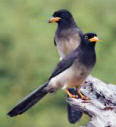 Brown Jay,
Psilorhinus morio, Corvidae family, endemic to the East costal
region of Mexico and the Yucatan and Central America, this corvid bird
is among the most intelligent birds known to science. Brown Jays vary in
plumage geographically, the Yucatan brown jays have deep brown wings
upper-parts and wings witn cream tips on tail plumage; their under parts
and belly is light cream. Bill and legs are deep yellow with orange
tones; eyes have a deep yellow ring. Their calls have a loud but low
pitched pee-ah tone. Very social and brave, nest has three to six eggs,
both parents build it and feed chicks. Feeds on insects, small seeds and
young fruits from various trees. Brown Jay,
Psilorhinus morio, Corvidae family, endemic to the East costal
region of Mexico and the Yucatan and Central America, this corvid bird
is among the most intelligent birds known to science. Brown Jays vary in
plumage geographically, the Yucatan brown jays have deep brown wings
upper-parts and wings witn cream tips on tail plumage; their under parts
and belly is light cream. Bill and legs are deep yellow with orange
tones; eyes have a deep yellow ring. Their calls have a loud but low
pitched pee-ah tone. Very social and brave, nest has three to six eggs,
both parents build it and feed chicks. Feeds on insects, small seeds and
young fruits from various trees.
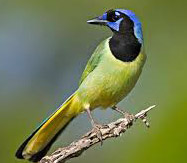 Green Jay,
Cyanocorax
luxosus,
this beautiful jay is known
to Yucatan's Maya as majestic "Ses Ib". Green jay body plumage stands out with beautiful shades of
deep lime and green on back and wings; deep yellow under tail feathers.
Its iridescent blue-violet head top contrasts beautifully with its black marking bib coming from the head sides and throat. The green tail has yellow feathers on each side that are seen as it flies. Green Jays inhabit well preserved low or medium forest,
feeding on fruits, tender shoots and flowers. Breeds and nests in deep foliage areas. Enjoys flying solitary but
known to fly in groups of two or more during mating season. Yucatan's side roads and open forest areas are perfect places to find the
green jay. Green Jay,
Cyanocorax
luxosus,
this beautiful jay is known
to Yucatan's Maya as majestic "Ses Ib". Green jay body plumage stands out with beautiful shades of
deep lime and green on back and wings; deep yellow under tail feathers.
Its iridescent blue-violet head top contrasts beautifully with its black marking bib coming from the head sides and throat. The green tail has yellow feathers on each side that are seen as it flies. Green Jays inhabit well preserved low or medium forest,
feeding on fruits, tender shoots and flowers. Breeds and nests in deep foliage areas. Enjoys flying solitary but
known to fly in groups of two or more during mating season. Yucatan's side roads and open forest areas are perfect places to find the
green jay.
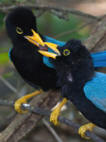 Yucatan Jay,
Cyanocorax yucatanicus,
called
Ch'el
in Maya,
is an
endemic
bird
species to the Yucatan Peninsula.
Protected at
Hacienda Chichen Bird Refuge,
where birders have the unique opportunity to see it enjoy many of the
fruits of the hotel's organic plantain orchard.
This is a jay with a brilliant
turquoise blue plumage on back and wings, bright yellow peak, feet,
and eyeliner, with black feather head, throat, and belly. Breeds in undisturbed wooded areas, nesting in small flocks.
Can be seen eating near
banana and fruit crops, or insects and seeds. Flies in small groups and enjoys pastures
and open fields; very talkative and social. The Yucatan Jay is
a medium size bird that can be observed all times of the day.
Adult birds have black peaks and feet. Yucatan Jay,
Cyanocorax yucatanicus,
called
Ch'el
in Maya,
is an
endemic
bird
species to the Yucatan Peninsula.
Protected at
Hacienda Chichen Bird Refuge,
where birders have the unique opportunity to see it enjoy many of the
fruits of the hotel's organic plantain orchard.
This is a jay with a brilliant
turquoise blue plumage on back and wings, bright yellow peak, feet,
and eyeliner, with black feather head, throat, and belly. Breeds in undisturbed wooded areas, nesting in small flocks.
Can be seen eating near
banana and fruit crops, or insects and seeds. Flies in small groups and enjoys pastures
and open fields; very talkative and social. The Yucatan Jay is
a medium size bird that can be observed all times of the day.
Adult birds have black peaks and feet.
BACK
TO BIRD GUIDE LIST
Mockingbirds:
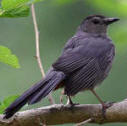
Gray Catbird,
Dumetella Carolinensis,
called
Box Chika' in Maya, is a mid-sized perching bird; the only
member of the "catbird" genus Dumetella of the Mimidae family. This
bird species is named for its cat-like call but it also mimics other birds
songs. Male and female birds look alike with plain grey plumage and
the head top darker, almost black, the undertail coverts are rust colored.
Gray
Catbirds enjoy perching inside bushes and small trees when choosing to sing
their many musical tones when hidden in undergrowth. These birds breed
in semi-open dense areas, they build bulky cup nests and lay pale turquoise
eggs (two or three). Both parents take turns feeding the young birds.
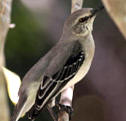
Tropical Mockingbird, Mimus gilvus, a resident
passerine bird from the Mimidae family. Both female and male are alikewith
grey plumage on the head and upper parts and a white-eye-stripe and dark
patch through its yellow eye. The Tropical Mockingbird long tail is
dark with white feather tips. These resident birds have a varied of musical
songs; enjoy eating insects and small wild berries. They build twig nests
that are aggressively protected by the female.
BACK
TO BIRD GUIDE LIST
Motmots:
The Motmots are a bird species called Toh
in
the Maya language, and can be observed regularly at the Hacienda Chichen Bird
Refuge and Maya Jungle Reserve. These near-passerine birds of the Momotidae
family are in the order of Coraciiformes. You can
find these motmots in woodlands and neotropical forests. Both spices
have beautiful and colorful plumage (see bellow photos), long racket like
tip tails, and heavy bill; they love to move their tail in a waging back and
forth motion when they detect predators. Toh birds, as the Maya call
them, eat small pray such as insects, lizards, and fruit. These species
enjoy forming large bird colonies and nest in bank tunnels and limestone
caves laying about four eggs; with both parents caring for the young.
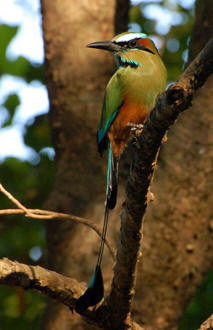
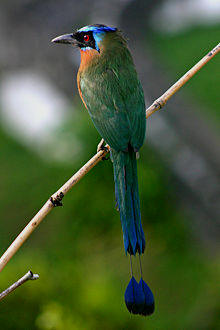
Turquoise-browed motmot, Eumomota superciliosa
Blue crowned motmot, Momotus momota
BACK
TO BIRD GUIDE LIST
Oriole Birds:
Oriole birds are passerine
birds in the New World family of Icteridae. These perching birds are
known as songbirds for the joyful melodic singing of their rich whistles.
Most orioles at Hacienda Chichen feed on insects, nectar and the Gumbo-limbo
fruits, Bursera simaruba. They have bright yellow and deep
orange color plumage with black and white marks near neck, tail, and in
their wing feathers. Fairly common to find each morning are the
following beautiful oriole species, do observe the different subdue markings
and plumage differences:
** The below Orange and Deep Yellow Oriole Birds are called Chel in Maya / Melodious Blackbird
is called Pi'ch:
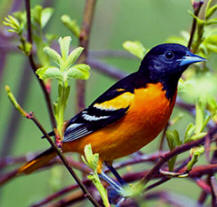
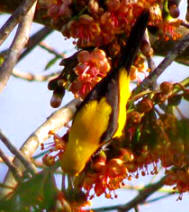
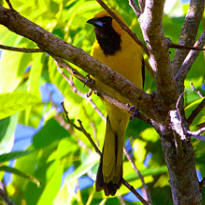
Baltimore
oriole,
Icterus galbula
Yellow-backed,
Icterus chrysater
Yellow-tailed,
Icterus mesomelas
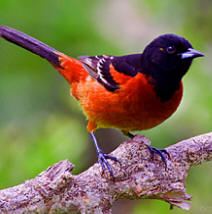
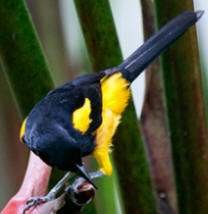
Orchard
oriole,
Icterus spurius
Black-Cowled
oriole,
I. Dominicensis Melodious black,
Dives dives
** The bellow beautiful Oriole Birds are called Yuyum in Maya:
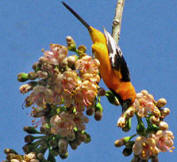
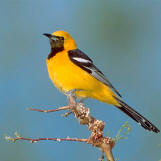
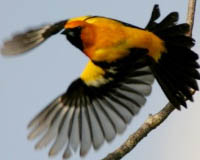
Altamira oriole, Icterus gularis
Hooded
oriole,
Icterus Cucullatus
Orange oriole, Icterus auratus
BACK
TO BIRD GUIDE LIST
Owl Birds:
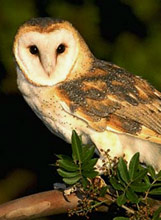
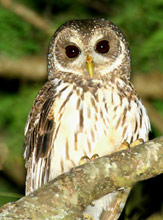
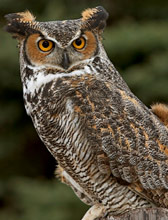
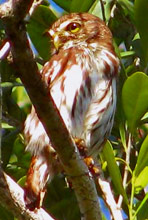
Barn owl
Mottled owl
Great horned owl
F. Pygmy owl
Barn owl, Tyto alba, lechuza común (Spanish) called
Xoch' in Maya. Primary a nocturnal sedentary owl with
high auditory acuity, the
only member of the family
Tytonidae (all other owls are from the Strigidae family).
Sometimes called the monkey-faced owl family, this medium sized owl is easy
to ID as it lacks ear tufts and has a distinctive heart shaped facial disk
unlike all other owls. Barn Owl enjoys warm weather and lowland
habitats, its diet is mainly wild rodents and reptiles. It builds its nest
sites in hollows or natural cavities in trees.
Ferruginous pygmy owl, Glaucidium brasilianum ridwayi,
Buho Viejita o Mochuelo Caburé (Spanish) called X'nuk
in Maya
It is a small sedentary owl with reddish-brown-rust
color and white plumage. You can hear
its calls fromyour own room patio terraces at Hacienda Chichen gardens and
observe pygmy owls during the early dusk (crepuscular hours) it is a
ferocious predator, feeds on small mammals, birds and reptiles, that nests
in tree cavities from all woodpecker holes and on tree depressions.
Both adults bring food to their young.
Great Horned owl, Bubo virginianus mayensis, called búho real (Spanish) and
Moan Ikim in Maya meaning the "wise-great-owl." This great
horned owl subspecies is only found on the Yucatan Peninsula. In
general, the Great horned owl is a family with 4 races and a native owl of
the Americas. The largest and most powerful of all owls found at
Hacienda Chichen Bird Refuge and private Maya Jungle Wildlife Reserve.
It has prominent horned ear tufts and a clear facial disk bordered with
black lines and has intense yellow-lime eyes. An adaptable sedentary
predator feeds on any small to medium creatures as it has a powerful feet
and a strong grip; perches and scans for pray before the hunt. Adapts
to most habitats; nests in caves and hollows quarries or even in cactus'
holes left by other birds. Both parents care for the young.
Mottled owl, Ciccaba virgata, a strictly nocturnal
owl found in the Yucatan to South America, its habitat is very extensive and
enjoys dwelling in forest areas and jungles such as that found in
Hacienda Chichen Maya Jungle Reserve.
Hunting from a perch, its diet consists on large insects, small mammals and
reptiles. Nests can be found in old palm holes during January and
February each year.
BACK
TO BIRD GUIDE LIST
Quails:
Black-throated bobwhite, Colinus nigrogularis, "Bech" in Maya.
Yucatan Quail,
Colinus virginianus
BACK
TO BIRD GUIDE LIST
Parrots:
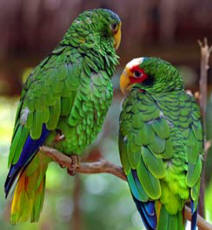
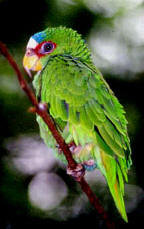
Yucatan Amazon Parrot
White-fronted parrot
Amazona xantholora, T’uut in Maya Amazona Albifrons
White-fronted parrot,
Amazona Albifrons, is found from
Southern Mexico to Central America. An easy to detect parrot for its clearly
marked bright red patch around the eyes and white forehead plumage; its body
is covered with bright green feathers and has a red shoulder wing-spot.
Strong yellow peak with dark tip. Flies in family groups in forests eating
nuts, berries, seeds and ripe fruits. Nests in tree hollows.
Olive-throated parakeet,
Aratinga nana, of the
Psittacidae family. Called
Periquito Verde (Spanish) or K'ijil (Maya) is found in Jamaica,
Mexico and Central America in a wide range of fragmented habitats and areas.
A very green looking parakeet with the head,
back and tail bright green and their throat olive green, the eyes are orange
with a dark iris, skin around the eyes is cream color.
Yucatan
Amazon Parrots or
Yellow Lored Amazon,
Amazona xantholora, "T'uut" in Maya, are one of the many
Yucatan endemic bird species found at
Hacienda Chichen Maya
Jungle Reserve, Chichen Itza, Yucatan. These lovely parrots of
Yellow lories are only found in the
Yucatan Peninsula, and a great family flock can be observed and
heard every day at sunrise and later in the day. These birds travel in flocks from feeding grounds
to their roosting sites. Parrots are
monogamous for life and become good pets; but are best enjoy flying
free in their medium forest habitat. Yucatan parrots love to fly together in small groups to feed on fruits, seeds, flowers
high on
tree branches. Talkative and noisy, their plumage is mainly
emerald green with indigo blue outline wing feathers; when in
flight, their red patched wings can be observed clearly. At the
forehead, these birds have a patch of yellow feathers near the peak,
a white spot covers the head top, red
feather near eyes.
BACK
TO BIRD GUIDE LIST
Plovers:
Killdeer,
Charadrius vociferus, rare
to observe at Hacienda Chichen Bird Refuge but does venture to inland
disturbed habitats and open fields.
Sparrows:
Olive sparrow, Arremmonops rufivirgatus,
also known as Green Finch, family Emberizidae, essentially
a Mexican bird species ranging up to Texas. It is a bush loving
species, Its plumage has olive colors in general with a set of dark lines in
its headline. A small seedeater bird that enjoys staying close to the
grown.
BACK
TO BIRD GUIDE LIST
Swifts:
Rufous-breasted Spinetail Synallaxis
erythrothorax
Vaux’s Swift, Chaetura vauxi
BACK
TO BIRD GUIDE LIST
Tanagers:
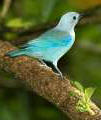 Blue-gray tanager, Thraupis episcopus Blue-gray tanager, Thraupis episcopus
Gray-headed tanager, Eucometis penicillata
Red-throated ant-tanager, Habia fuscicauda
Red-legged honeycreeper, Cyanerpes cyaneus
Rose-throated tanager, Piranga roseogularis – rare to observe
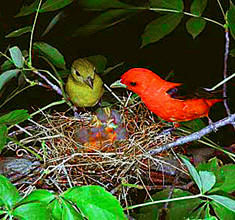
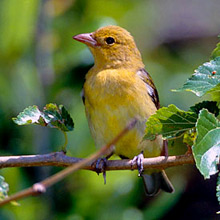
Scarlet tanager: male (left
photo), feeding their young (center photo) female (right
photo)
Scarlet tanager birds,
Piranga Olivacea,
formally classified in
the tanager family Thraupidae now its genus is in the cardinal family
Cardinalidae. Scarlet tanager's plumage and vocalization are similar
to their cardinal family members. Adults males plumage is bright scarlet red
with black wings and tail, while scarlet females have yellowish under-parts,
olive tops, brown wings and tail. Juvenile scarlet birds show complex
variegated plumage. They breed in May and stay till
October foraging high in tree tops. Eat insects in flight but enjoy small
berry fruits, building their nests in horizontal high branches.
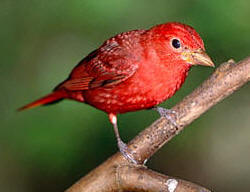 Summer
tanager, Pirunga rubra Summer
tanager, Pirunga rubra
Western tanager, Piranga ludoviciana
Yellow-winged tanager, Thraupis abbas
BACK
TO BIRD GUIDE LIST
Thrushes and Swallows:
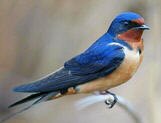
Barn swallow
Cave swallow
Clay
colored robin Louisiana Waterthrush
Purple Martin
* Barn swallow, Hirundo rustica.
A distinctive worldwide
spread passerine bird with blue
upperparts, a long, deeply forked tail and curved, pointed wings.
Enjoys feeding on insects caught while it flies. Barn swallows tend to
be comfortable around humans and perches in electric cables and man-made
structures. Enjoys open space areas as its habitat.
*
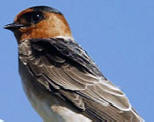
Cave swallow, Petrochelidon fulva
-
Its located
mainly in central south Mexico, with isolated permanent groups in Chiapas
and upper Yucatán peninsula where the Cave shallow flocks prefer cenotes and caves
as their habitats, which they shared with bats in Yucatan. This shallow visits the Hacienda Chichen pool area almost daily
for a drink of water. Easy to recognize for their brown tangerine forefront
and throat with blue gray upper-parts, tail is square and bill very small.
Feeds on small insects. Nests in tunnels and caves.
(center
left photo above text)
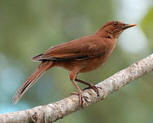
* Clay
colored robin,
Turdus greyi, ( X'Kok in Maya ) This songbird has a rather
low-pitched and with a slow steady tempo, consists of many slurred
musical notes, often repeated irregularly. Loves to feed on ants and
other insects, also small fruit seeds found in the ground.
(center,
third photo above text)
Cliff swallow, Petrochelidon pyrrhonota
it is from
same family as the cave swallow found in Hacienda Chichen Bird Refuge and
gardens all year round though it is a migratory bird. Females lay 2 to 4
pale blue eggs with red-brown and gray markings between March and July
and are known to eject parasite bird eggs from their nests.
Gray-cheeked thrush,
Turdus
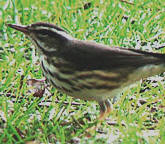
* Louisiana waterthrush,
Seiurus motacilla, this migrant small thrush has plain brown back
and white underparts streaked with black. The flanks and undertail are
buff, with a strong white flared supercilium, and the legs are bright
pink. The male's song is a musical with distinctive descending notes.
(center
right photo above text)
Northern rough-winged swallow, Stelgidopteryx serripennis
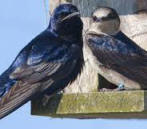
* Pulple martins, Progne subis, the largest swallow in
North America. Males have dark, glossy blue-black plumage; females and
immature birds are duller above and grayish below. The purple martin is
an extremely popular and well-known bird. Known for its series of
chortles, gurgles, and slightly harsher croaking singing notes and
calls.
(side
right top
photo above)
Ridgway’s rough-winged swallow, Stelgidopteryx ridgway - "Cutzam"
in Maya. This brown-backed, dusky-throated little swallow prefers open
areas, including those in human-made structures. Females nest singly or in small colonies in
burrows or crevices. It feeds over water, more than most species of
swallows, and occasionally picks floating insects from the water
surface.
Swainson’s
thrush,
Catharus ustulatus, these birds migrate to southern Mexico, and
as far south as Argentina. Swainson's thrush tends to keep away from
noisy areas and human contact.
Tree swallow, Tachycineta bicolor
Wood thrush,
Hylocichla mustelina
BACK
TO BIRD GUIDE LIST
TINAMOUS:
Thicket Tinamou, Crypturellus cinnamomeus
BACK
TO BIRD GUIDE LIST
Tityra and Bacard:
Black crowned tityra,
Tityra inquisitor
(Pelan K'euel
in Maya)
Mask tityra,
Tityra semifasciata, (Pelan K'euel in Maya)
Rose-throated bacard,
Piranga roseogularis.
BACK
TO BIRD GUIDE LIST
Toucan and Aracari:
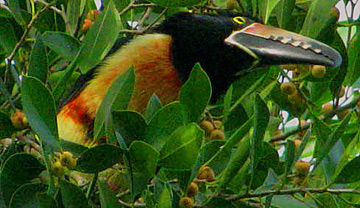
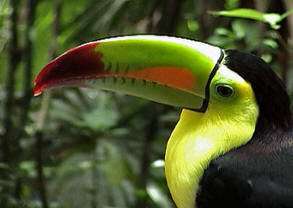
Collared Aracari, Pteroglossus torquatus
Toucan,
Keel-billed, Ramphastos sufuratus
BACK
TO BIRD GUIDE LIST
Turkey:
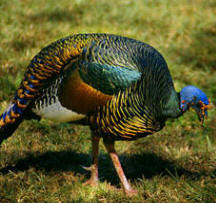 Ocellated
Turkey,
Agriocharis ocellata,
this wild bird is one of the many endemic bird species of Yucatan and it is protected in
our Nature Reserve, is known to the Maya as the grand "Kutz". Males have a lovely plumage of iridescent golden yellow, violent, indigo
blue, metallic greens and white; their head and neck color has deep hues of blue and violet with protuberances like
a domestic turkey. Their tails have a semi-circular pattern near the end of the feathers.
Ocellated
Turkey,
Agriocharis ocellata,
this wild bird is one of the many endemic bird species of Yucatan and it is protected in
our Nature Reserve, is known to the Maya as the grand "Kutz". Males have a lovely plumage of iridescent golden yellow, violent, indigo
blue, metallic greens and white; their head and neck color has deep hues of blue and violet with protuberances like
a domestic turkey. Their tails have a semi-circular pattern near the end of the feathers.
Found only in Yucatan, the Oscellated turkey feeds on seeds, shoots or insects, lives in small family groups within deciduous low bush forest. A ground dweller that can not be domesticated and nests in dense forest spots, sleeping at tree top branches. Mayan families enjoy to eat these shy and easy to disrupt birds.
BACK
TO BIRD GUIDE LIST
Trogons:
Trogon
family of birds has 36 species that reside in tropical forests worldwide.
This bird species loves to perch and has only one family, the Trogonidae.
The word "trogon" in Greek means "nibbling" and it refers to the birds
building tree nest holes. Two trogon bird species are found at
Hacienda Chichen, Chichen Itza, Yucatan, Mexico, both reside at the
hotel's Bird Refuge and can be seen eating insects and fruits perching
serene on their arboreal habitats; they are generally sedentary.
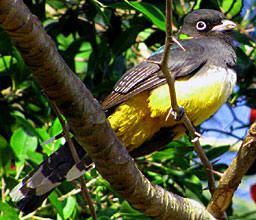
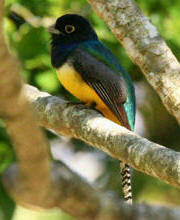
Black-headed Trogon, Trogon Melanocephalus. Violaceus
trogon,
Trogon
violaceus
BACK
TO BIRD GUIDE LIST
VULTURES:
American Black vulture, Coragyps atratus
Turkey
vulture,
Cathartes
aura
BACK
TO BIRD GUIDE LIST
Vireo Birds:
Males of most vireo bird species are persistent singers. Vireos
feed mainly on small insects, fruits and seeds.
Lesser greenlet. vireo, Hylophilus decurtatus
Mangrove vireo,
Vireo pallens
Red-eyed vireo,
Vireo olivaceus
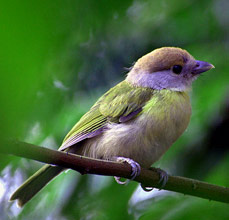
Rufous-browed peppershike
Cyclarhis gujanensis
Warbling vireo, Vireo gilvus
White-eyed vireo, Vireo griseus,
Yellow-green vireo, Vireo flavoviridis,
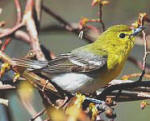
Yellow-throated vireo,
Vireo flavifrons
Yucatan vireo, Vireo magister,
BACK
TO BIRD GUIDE LIST
Warbler Birds:
American
redstart warbler,
Setophaga ruticilla
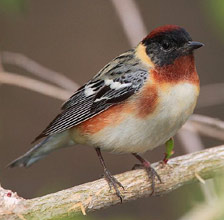
Bay-breasted warbler
Dendroic castaneaa
Blue-winged
warbler,
Vermivora
pinus
Black-and-white warbler,
Mniotilta varia
Blackpoll warbler,
Dendroica
straita
Black-throated blue warbler,
Dendroica caerulescens
Black-throated green warbler,
Dendroica virens
Black and
white warbler,
Mniotita varia
Cape May warbler,
Dendroica
tigrina
Cerulean warbler,
Dendroica cerulea
Chestnut-sided warbler,
Dendroica pensylvanica
Common
yellowthroat warbler,
Geothlypis trichas
Kentucky
warbler,
Oporomis
formosus
Louisiana waterthush,
Seiurus motacilla,
this
migrant small thrush has plain brown back and white underparts streaked
with black. The flanks and undertail are buff, with a strong white
flared supercilium, and the legs are bright pink. The male's song is a
musical with distinctive descending notes.
Gray-crowned yellow-throat,
Geothlypis poliocephala
Hooded warbler,
Wilsonia
citrina
Magnolia warbler,
Dendroica
magnolia
Northern
Parula,
Perula americana
Northern
waterthrush warbler,
Parkesia noveboracensis
Ovenbird
warbler,
Seiurus
aurocapillus
Palm
warbler,
Dendroica
palmarum
Prairie warbler,
Dendroica
discolor
Prothonotary warbler,
Protonotaria citrea
Tennessee
warbler,
Vermivora
peregrina
Yellow warbler,
Dendroica
petechia aestiva
Yellow-breasted Chat,
Icteria virens
Yellow-rumped warbler,
Dendroica coronata
Yellow-throated warbler,
Dendroica dominica,
BACK
TO BIRD GUIDE LIST
WAXWINGS:
Cedar
waxwing,
Bombycilla
cedrorum
BACK
TO BIRD GUIDE LIST
Woodpeckers
and Woodcreeper Birds:
All woodpeckers
and woodcreeper birds are called Colonte in Maya, at Hacienda Chichen
private Bird Refuge and Wildlife Sanctuary in Chichen Itza, Yucatan, Mexico.
Woodpeckers are a family of near-passerine birds Picidae. Most species
live in woodlands habitats, feeding on insects and some small seeds.
There are ten species of this genera residing in our gardens and Maya
jungle. The Ivory-billed woodpecker is extinct in many parts of the
world but has been observed in our property by renown bird-watchers such as
Barbara MacKinnon and naturalist Jim Conrad.
Woodcreepers are passerine birds endemic to the Neotropics with their
distinct family Dendrocolaptidae; they keep an upright vertical posture
thanks to their stiff tail vanes. Woodcreepers feed mainly on
insects and like woodpeckers they are arboreal cavity-nesting birds.
Woodpeckers and woodcreepers have stiffened tails, used as prop, crucial
for their climbing and foraging. View our photo album of both species bellow to identify
which bird you have observed while staying with us:
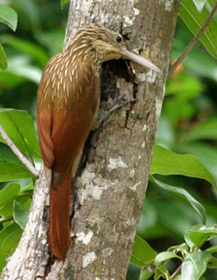
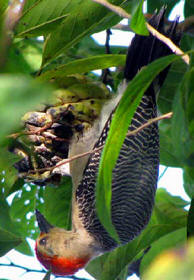
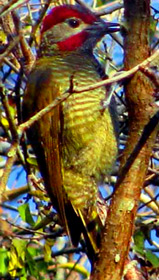
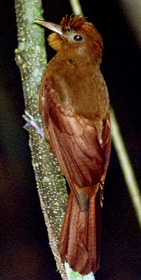
Ivory-billed woodcreeper Golden-fronted
woodpecker Golden olive woodpecker
Ruddy woodcreeper
Xiphorhynchus
flavigaste Centurus
aurifrons
Piculus
Rubiginodud
Dendrocincla homochroa
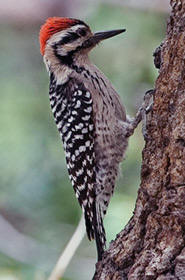
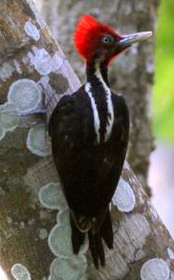
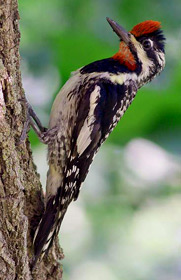
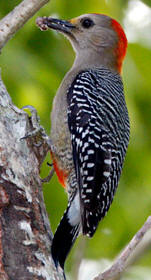
Ladder-backed woodpecker Pale-billed woodpecker
Yellow-bellied sapsucker
Yucatan woodpecker
Picoides
scalaris Campephilus
guatemalensis Spyrapicus varius Melanerpes pygmaeus
Lineated woodpecker,
Dryocopus
lineatus
Olivaceous woodcreeper,
Sittasomus
griseicapillus
BACK
TO BIRD GUIDE LIST
WRENS:
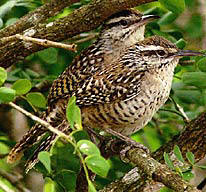 Carolina wren, thryothorus ludovicianus Carolina wren, thryothorus ludovicianus
House wren, Troplodytes aedon
Spot-breasted wren, Thryothorus maculipectus
Southern house wren, Troglodytes aedon
White-browed wren,
thryothorus albinucha
White-bellied wren, Uropsila leucogastra
Yucatan wren, Campylorhynchus yucatanicus, called "
Yan coti" in Maya (see Yucatan endemic birds).
BACK
TO BIRD GUIDE LIST
Yucatan
Endemic Birds:
look also for
each bird group
Mexican sheartail, Dorich eliza, endemic emerald green
humming bird, "Dzunum" in Maya.
Ocellated Turkey,
Meleagris ocellata – endemic species
Yucatan bobwhite,
Colinus nigrogularis,
"Bech" in Maya.
Yucatan flycatcher,
Myiarchus yucatanesis,
known in Maya as a " X'takay "
Yucatan Jay,
Cyanocorax yucatanicus,
endemic.
Yucatan
nightjar,
Caprimulgus badius, called "Box Pujuy" in Maya.
Yucatan
nightjar,
Caprimulgus badius, called "Box Pujuy" in Maya, is very
similar to the Yucatan poorwill and non-professional birders may confuse
both in field.
Though their plumage
is extremely similar in eavy spotted pattern and color that blend
perfectly with its semi-arid scrubby habitat, Yucatan nightjar has more white at the
tip of his tail and
wider white forecollar. Their nocturnal call notes are very rhythmic clear and very
loud. They enjoy same habitat ambience as the Yucatan poorwill,
and they also lays their eggs on the ground around April / Aug. Both
parents attend the incubation of no more than two elliptical white eggs
with sparsely flecked with brown shades. This is a very sedentary bird
that feeds mainly on insects and is highly territorial.
Yucatan
amazon parrot or Yellow lored amazon, Amazona xantholora, "T'uut" in Maya, are one of the many
Yucatan endemic bird species found at
Hacienda Chichen Maya
Jungle Reserve, Chichen Itza, Yucatan. These lovely parrots of
Yellow lories are only found in the Yucatan Peninsula, and a great
family flock can be observed and heard every day at sunrise and later in
the day. These birds travel in flocks from feeding grounds
to their roosting sites. Parrots are monogamous for life and become good
pets; but are best enjoy flying free in their medium forest habitat.
Yucatan parrots love to fly together in small groups to feed on fruits,
seeds, flowers high on tree branches. Talkative and noisy, their plumage
is mainly emerald green with indigo blue outline wing feathers; when in
flight, their red patched wings can be observed clearly. At the
forehead, these birds have a patch of yellow feathers near the peak, a
white spot covers the head top, red feather near eyes
Yucatan poorwill,
Nyctiphrynus yucatanius,
called "Chac Pujuy" in Maya, this endemic mid-size nightjar
belongs to the Caprimulgidae family. It is protected at Hacienda
Chichen's private Nature Reserve.
Nocturnal and very territorial; enjoys quiet semi-arid deciduous forest
areas, feed on insects from ground and perches on tree. Male emits
repetitive loud rhythmic calls at dusk.
Males and females have similar plumage that blends perfectly with bark
and dry leafs making it difficult to spot. Upperparts brown streaked
brown-blackish, distinct spot on wing-coverts, a narrow white neck band,
and truly small peak. Lay eggs on the ground, both parents caretakers.
Yucatan Quail,
Colinus virginianus
Yucatan vireo,
Vireo magister, (see verios)
Yucatan woodpecker,
Amazilla
Yucatan wren, Campylorhynchus yucatanicus, called "
Yan coti" in Maya.
BACK
TO BIRD GUIDE LIST
Visit Our Sponsored Sites:
 |